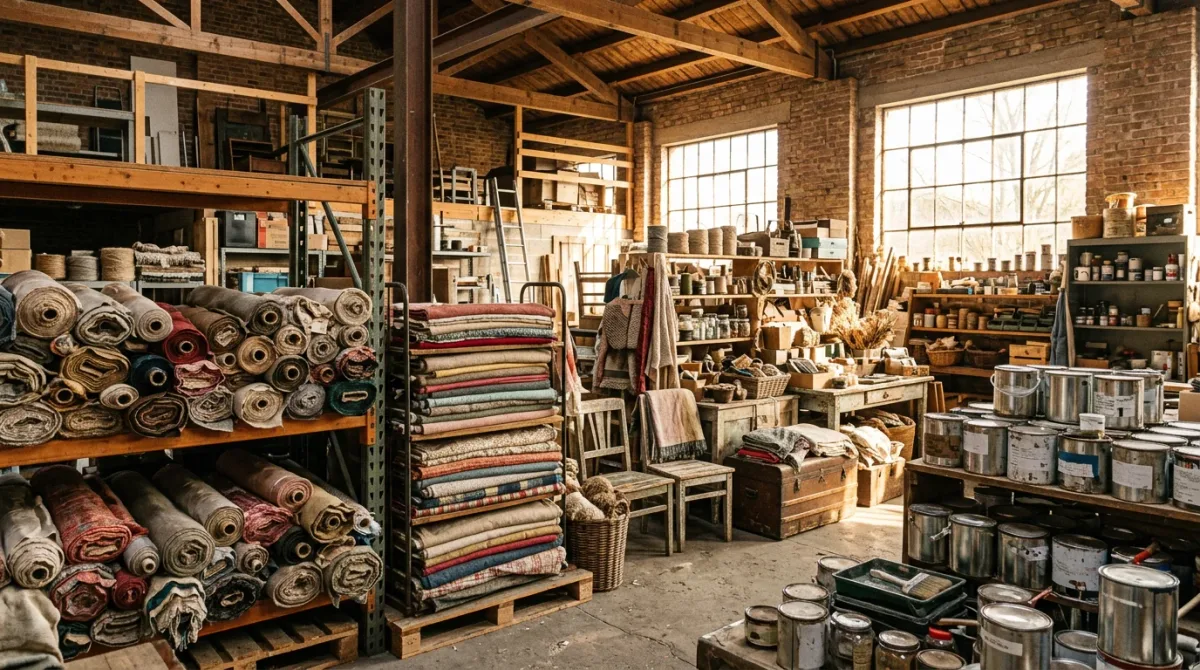
Materials for the Arts runs a free, 35,000-square-foot warehouse in Long Island City where eligible New York City nonprofits, public schools, and fiscally sponsored artists can shop twice a week for donated fabric, paint, furniture, electronics, and craft supplies — no money changes hands, and no purchase minimum applies. The program has quietly become one of the largest supply lines for artists working outside gallery budgets, and almost none of them found out about it from a gallery.
Run by the Materials for the Arts program under the city's Department of Cultural Affairs, the operation sits inside a former industrial building at 33-00 Northern Boulevard in Long Island City. Businesses clearing office space, downsizing inventory, or closing up shop drop off what they no longer need — bolts of fabric, art books, props, frames, office supplies — and city agencies, nonprofits, and schools take it, free, instead of buying it new. It is, functionally, a reuse economy for people who can't afford a supply run to Blick.
What Is Materials for the Arts, Exactly?
Materials for the Arts (MFTA) collects unneeded items from businesses and individuals and redistributes them at no cost to nonprofit arts programs, government agencies, and public schools across the five boroughs. It is a New York City Department of Cultural Affairs program, with the nonprofit Friends of Materials for the Arts helping run education programming and warehouse operations alongside the city.
The scale is not small. Executive Director Tara Sansone has described the center's job as intercepting the disposal process before it happens — pulling usable goods out of the waste stream and putting them back into classrooms and studios instead of a landfill, a mission she outlined to CBS New York, which called MFTA one of the largest creative reuse centers in the country. According to that reporting, nearly 2,000 city public schools now use the center, and roughly 1.5 million pounds of donated goods move through the warehouse in a typical year.
Who Can Actually Get In the Door?
MFTA membership is open to nonprofit organizations that have run arts or cultural programming for at least two years, public schools, government agencies, and social-service, health, or environmental nonprofits that maintain ongoing art programs. Private schools and early-childhood or Pre-K programs are not eligible for regular member accounts. Most New York City public schools are already signed up: 93 percent of Department of Education schools have active MFTA recipient accounts, meaning a teacher at most schools doesn't need to apply — the school's account already exists.
Can an Individual Artist Use It, or Only Nonprofits?
An individual artist cannot join on their own. Individual artists working on a project in a public setting may qualify for access, but only if they are fiscally sponsored by a nonprofit organization — meaning a registered nonprofit takes on the administrative and legal responsibility for the project, and the artist shops under that nonprofit's account. For an emerging artist without institutional backing, that means the fastest way in is partnering with — or getting fiscally sponsored by — an arts nonprofit that already has, or can get, a recipient account.
How Do You Sign Up and Book a Shopping Appointment?
New members apply online and submit documentation to the program's applications inbox; once an executive director or school principal signs off, the account is approved and activated. Existing members should confirm their status before reapplying, since duplicate accounts slow the process down. Once active, members log into the MFTA online portal to book a shopping appointment — the warehouse is open for shopping only on Tuesdays and Thursdays, in two-hour windows, and each organization can hold only one appointment at a time. A primary contact, account manager, or staff representative may bring up to two additional helpers, for a maximum of three shoppers per visit.
What Kind of Materials Are Actually on the Shelves?
Donations accepted by the warehouse include bolts of fabric, paper, art books, office supplies, electronics, props, paint, frames, craft supplies, and furniture. The program does not accept weapons, medicine, or dangerous or toxic chemicals. According to the program's published eligibility and shopping rules, members receive an itemized invoice documenting what they take at each appointment, but there is no stated numeric cap on the amount collected per visit — the limit in practice is the two-hour window and what three people can carry out.
How Does Donating to MFTA Work?
Donors can drop items off at the warehouse's loading dock Monday, Wednesday, and Friday between 9 a.m. and 3 p.m., ship smaller donations by mail, or — for large corporate donations — request a free pickup, typically scheduled three to four weeks out. Donors who want a tax receipt must declare the value of what they're giving; MFTA then provides a letter for tax purposes. The program also runs a separate listing where donors post items online and recipient organizations arrange pickup directly, bypassing the warehouse floor entirely.
Why Does This Matter Beyond Free Stuff?
For an artist-run space or a teaching artist working a second job, materials cost is one of the quieter reasons ambitious projects don't happen — a mural gets scaled down, a set doesn't get built, a costume gets improvised badly. A program that treats surplus fabric and hardware as infrastructure rather than trash changes what's actually possible on a shoestring budget, particularly for the school-based and community arts programming that rarely shows up in gallery coverage but is where most working artists in this city actually teach, build sets, and get paid. It is also, in the plainest terms, a climate program: keeping roughly 1.5 million pounds of usable material a year out of landfill isn't incidental to the arts mission, it's the other half of it.
Frequently Asked Questions
Does it cost anything to join Materials for the Arts?
No. Membership and shopping are free for every eligible organization — nonprofits, public schools, government agencies, and qualifying social-service nonprofits with ongoing art programs. There is no membership fee, and no charge for what members take from the warehouse floor.
Can a for-profit gallery or business register as a member?
No. Recipient accounts are limited to nonprofit organizations with at least two years of arts programming, public schools, government agencies, and eligible social-service or health nonprofits — for-profit galleries and businesses are not eligible to shop as members, though businesses are welcome to donate.
What if my school or organization already has an account?
Check first. Because most Department of Education schools and many established nonprofits already have active recipient accounts, the program asks prospective members to confirm existing status by email before submitting a new application, to avoid duplicate accounts.
Where is the warehouse and when can I shop there?
The warehouse is at 33-00 Northern Boulevard in Long Island City, Queens. Shopping appointments run only on Tuesdays and Thursdays in two-hour windows, booked in advance through the member portal; donation drop-offs are accepted separately on Monday, Wednesday, and Friday mornings and early afternoons.
For a related art perspective, read How New York City's Percent for Art Law Pays Working Artists.