Every conversation about who gets to be an artist in New York eventually lands on talent, luck, and networks. All true, and all of it arrives after a quieter gatekeeper has finished voting: the price of the degree. The MFA remains the art world's default credential — the two years that deliver a studio, a critique circle, a thesis show, and the beginnings of a professional network. It is also, for most people, one of the most expensive purchases of their lives, made at the exact moment their income is lowest. Tuition does not just charge artists. It selects them.
What does an art degree actually cost a New Yorker?
Realistically, twice what the brochure says. Two years of private-school tuition in New York stack on top of two years of city rent, materials, insurance, and the income an artist gives up by being in school. The total behaves like a small mortgage — except mortgages come with a house, and MFAs come with a studio visit schedule and a thesis exhibition that lasts nine days.
The asymmetry is the part nobody puts on the website. Law and medical students also borrow heavily, but they enter professions with salary structures designed to repay loans. Art careers have no such structure: incomes are intermittent, concentrated late if at all, and median earnings sit far below the professions art schools price themselves against. Borrowing at professional-school rates to enter an unstructured market is not an education decision. It is a leverage decision, and it filters applicants before a single portfolio is opened.
What does fully funded actually mean?
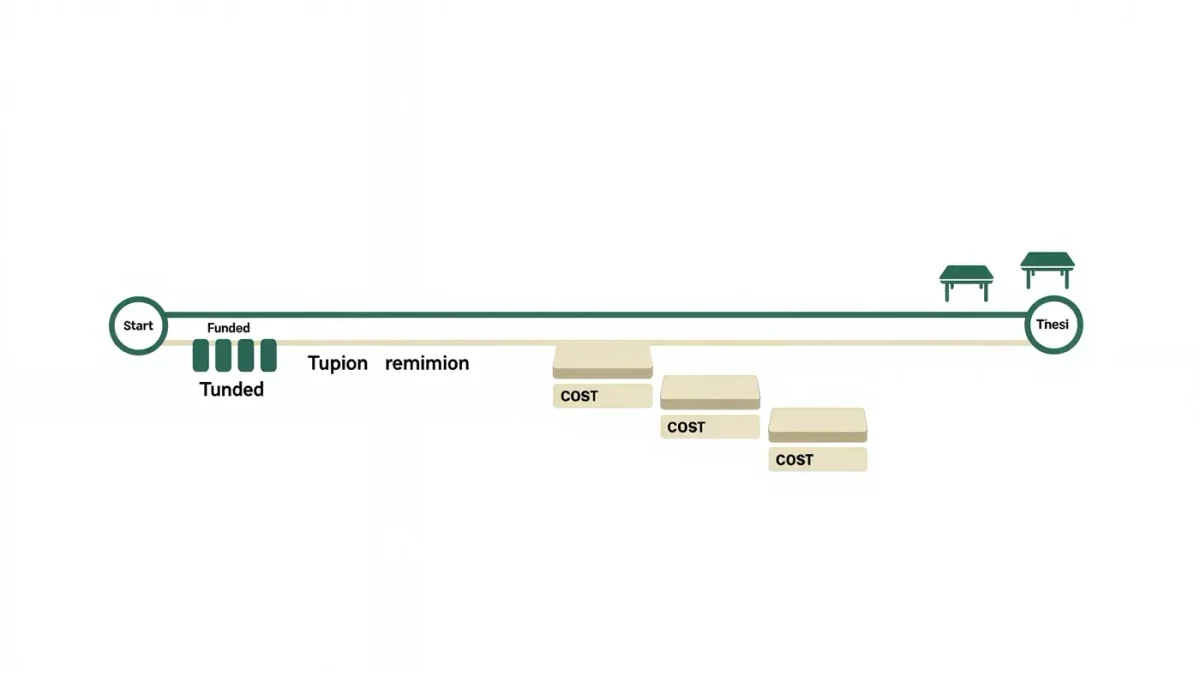
It means tuition remission plus a living stipend, usually in exchange for labor. Fully funded MFA students teach undergraduates, staff studios, or assist research, and the stipend functions as a wage for work the program needs done anyway, per fellowship-resource guides like ProFellow's. It is a real job with a real paycheck — modest, conditional, and the difference between graduating with a network and graduating with debt.
Artists evaluating programs should read funding offers the way they would read any employment contract. What is the stipend, and what duties does it require? Does funding continue in the second year, or does it evaporate? Is health insurance included? A program that answers these questions vaguely is answering them.
Which programs have gone tuition-free?
A small but growing set, led by a notable example: Carnegie Mellon University's School of Art, which announced its MFA would be tuition-free and now states that every MFA student receives full tuition funding regardless of background or citizenship status, per the program's own materials. The policy shows the model is not hypothetical — a university can simply decide that its graduate artists should not pay tuition, and then fund them.
The significance is not that everyone should move to Pittsburgh. It is that tuition-free MFAs exist, which converts the question from whether artists can be funded to whether institutions choose to fund them. Every program that keeps charging what New York programs charge is now making that choice in public, with a counterexample one search away.
How does tuition change who applies in the first place?
It changes the pool before the pool is ever judged. Debt-averse applicants, first-generation students, artists supporting families, and anyone who has already lived through financial precarity tend to look at the total cost and rationally decline the bet. What remains skews toward the wealthy and the risk-tolerant, which quietly reshapes who is in the room during critique, who can afford the unpaid internship afterward, and whose thesis show a dealer happens to walk through.
Then the filter compounds. MFA cohorts feed the teaching jobs that sustain mid-career artists, the networks that circulate exhibition opportunities, and the city's residency applications. If the gate was expensive, the people behind it carry the expense forward — either as debt they must service with unrelated work, or as family money buying them time. Either way, the economics of the degree become the economics of the scene, and the scene becomes less like the city it sits in.
The filter also reaches backward into the labor model that runs art schools themselves. Graduate programs are staffed, in large part, by practicing artists teaching as adjuncts — the very graduates the system produced — paid per course without benefits or security. The expensive degree buys entry into a hiring queue whose wages cannot repay it, which keeps artists dependent on family money, a partner's income, or endurance. Tuition does not just pick the students. It picks the faculty, and through them, the aesthetics and etiquette of every critique to come.
Are there cheaper routes to the same room?
Yes, and New York is unusually rich in them. Public university programs charge a fraction of private tuition, continuing-education courses sell critique and community without a degree, and the city's artist-run spaces, open-studio weekends, and shared buildings have launched careers with no credential at all. The degree is one door among several, not the building.
One more New York-specific wrinkle deserves honesty. The city's own MFA programs sit inside the most expensive student-housing market in the country, and stipends calibrated for Pittsburgh or Iowa City do not survive contact with a Brooklyn lease. Some students commute from farther out, some crowd into shared apartments well into their thirties, and some never apply at all. The geography of who can attend a New York MFA is, in practice, a map of who can afford to live near one.
The honest framing is economic, not romantic. Cheaper routes trade money for time and hustle: no institution schedules your studio visits, so you build the network by hand, show by show. For artists who can absorb that labor, skipping the debt is often the sharper financial decision. The point is that it should be a decision — made with the real numbers in front of you, not with the art world's mythology about what an MFA is required for.
What would actually fix this?
More funded seats, and honestly advertised ones. Every art school should publish what percentage of its graduate students pay full freight, what stipends attach to which duties, and what graduates' debt looks like — the way federal loan rules eventually forced undergraduate programs to disclose outcomes. Applicants should demand those numbers before paying an application fee, and treat a program that will not share them as a data point in itself.
Stipends deserve the same scrutiny as tuition waivers: a funding package indexed to a distant cost of living is a pay cut disguised as generosity, and applicants should run the numbers against actual rents before accepting. In the meantime, the working rule for artists is simple. Never borrow professional-school money for an unstructured career. Take the funded seat, the public program, or the self-built path, and keep the debt out of the studio — because the people tuition screens out are not the people art can afford to lose.