In 2006, Austria handed five Klimt paintings back to Maria Altmann, the Austrian-American who fled Vienna after Nazi Germany took over and stripped her family. The return still stands as the largest single restitution of Nazi-looted art in Austria's record. It reset what museum walls owe the people behind the frames.
Restitution is not a footnote to the art world. It is daily work: registrars, archives, and claims. It decides which pictures hang, and under which names. The line runs from the organized theft of a continent to eleven principles signed in Washington. Families carry it, decade after decade, with their papers and their patience. This connects to our earlier piece, How New York Artists Register to Legally Sell Their Own Work.
What the Nazis Took From Europe's Walls
Nazi authorities stripped art and valuables from occupied countries across Europe. In Germany itself, the looting of Jewish property was a key part of the Holocaust. Paintings, ceramics, books, and religious treasures moved by direct seizure and forced transfers. Some moved under the cover of art-protection units. Senior figures built private collections on the spoils.
Recovery after the war was real and partial. The Allies' Monuments, Fine Arts, and Archives program brought many works back. Many more stayed missing, or went back to countries rather than to owners. The international effort to trace the rest is still running. Its stated aim is return to the rightful owners.
The Eleven Principles That Reset the Field
In December 1998, representatives of 44 governments and 13 non-governmental groups met in Washington. They issued eleven principles on art confiscated by the Nazi regime. The principles are non-binding, and the text says so plainly: nations act within their own laws.
Practice changed. The principles call for finding confiscated art, opening records and archives, and publicizing finds. They also ask panels to weigh gaps in a work's provenance against the passage of time and the facts of that era. Provenance means the chain of ownership, written down. It moved from a filing cabinet to a museum's public duty. For related coverage, see How New York City Actually Hands Out Public Art Commissions.
Maria Altmann's Sixty-Year Fight
Altmann fled Vienna after the takeover. Her husband was arrested and held at the Dachau camp. His brother was forced to sign over a factory. The couple escaped, leaving home and property behind, and rebuilt a life in Los Angeles. Her family's Klimts, including portraits of her aunt Adele Bloch-Bauer, stayed in Austria.
Decades later she sued. In 2004, the Supreme Court of the United States ruled that Austria was not immune from the suit. The two sides agreed to binding arbitration. In January 2006 the panel ruled that Austria was legally required to return the paintings. In March, it did. The works were estimated at some 150 million dollars. That made it the largest single return of Nazi-looted art in the country's record. One of the five, the 1907 gold portrait of Adele Bloch-Bauer, reached public view that summer at the Neue Galerie in New York.
Who Does the Provenance Work Now?
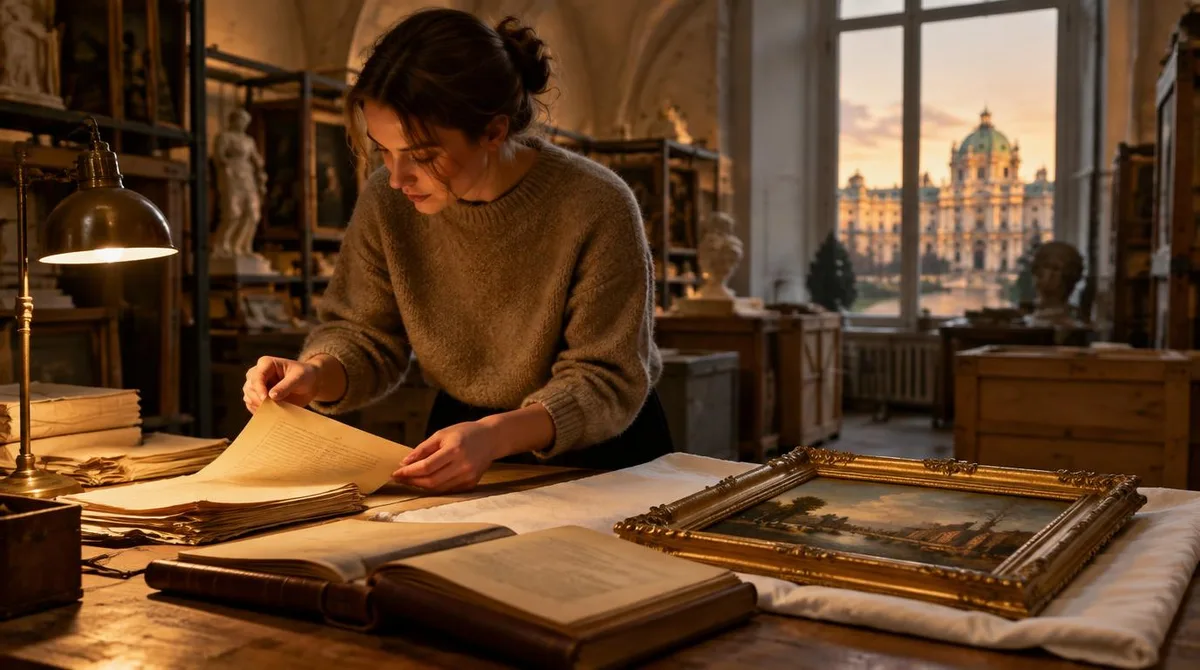
Families do much of it, with museum researchers beside them. The Washington framework puts the labor in writing: resources and people to identify art, records open to researchers, finds made public so claims can take shape. In practice that means provenance registrars combing files, archivists digitizing records, and heirs reading old catalogues line by line.
The ledger stays open by design. A painting can hang for decades before its caption changes. When it does, the wall text carries a family's history beside the artist's. That is the standard the field now measures itself against. Slow is not the same as closed.
Conclusion: Names Before Numbers
Provenance and restitution are one story at two speeds. First the papers, then the return. The Washington Principles set the frame in 1998. Altmann's case proved a family could win inside it. Museums that do this work are telling the truth about how art arrived. The people behind the frames come first. They always were the story.