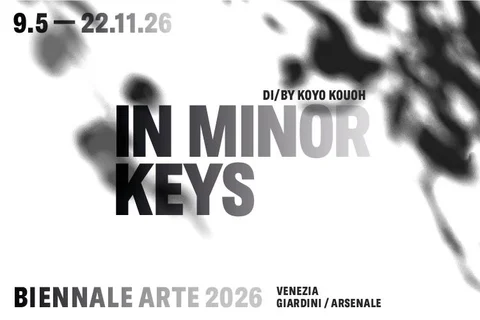
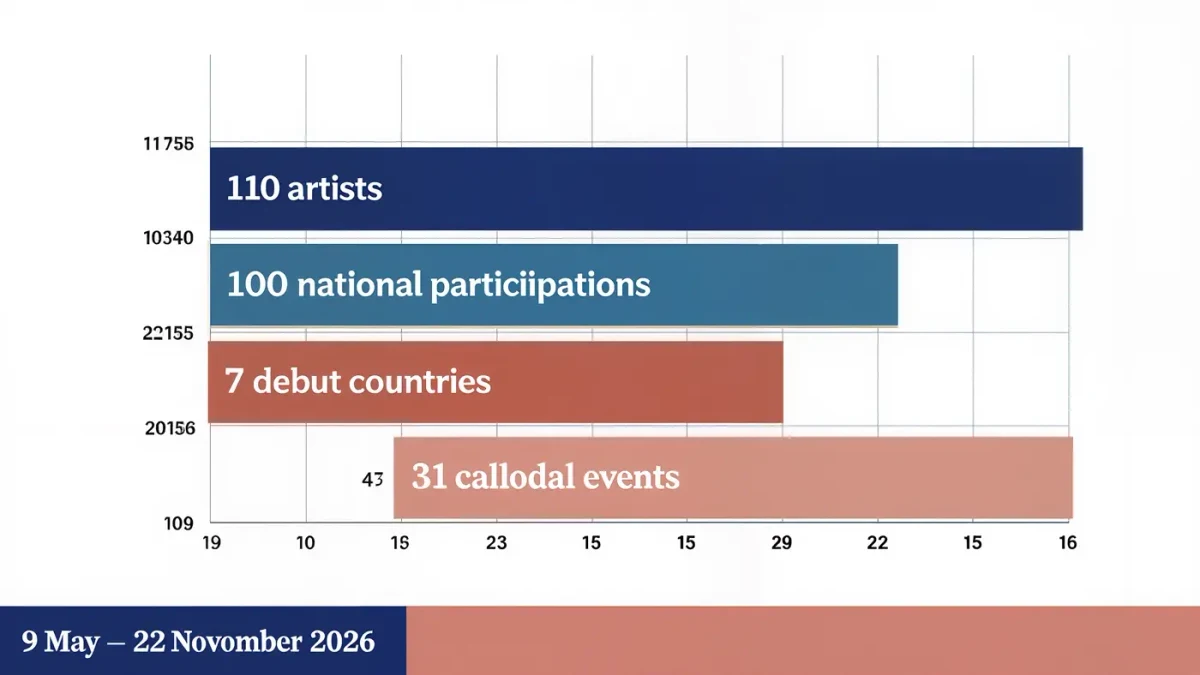
On February 25, 2026, La Biennale di Venezia announced 110 invited participants for the 61st International Art Exhibition, titled In Minor Keys and curated by Koyo Kouoh, which runs May 9 through November 22, 2026, per the biennale's announcement. The list includes individual artists, collaborative duos, collectives, and artist-led organizations.
List day is the art world's draft. One morning the names drop, and by evening the selected are rescheduled — biennials ship work, pay fabrication, fly artists to the opening, and put them in front of a global audience in a way almost nothing else does. For the unlisted, which is nearly everyone, it is worth reading the announcement closely, because it is one of the few documents that shows how selection actually works at the top of this business.
Per La Biennale's announcement, Kouoh assembled the list with advisors Rasha Salti, Gabe Beckhurst Feijoo, and Marie Helène Pereira, paying what the announcement calls particular attention to resonances, affinity, and possible convergences between practices, even when far apart. The show builds on what the biennale describes as Kouoh's relational geography of encounters with artists over her lifetime, and the announcement cites places her looking ranged across — Salvador, Dakar, San Juan, Beirut, Paris, and Nashville.
Notice what is absent from that sentence: applications, open calls, submission portals. Nobody pitched this edition into existence. The list is the residue of decades of looking — studio visits, small shows, catalogues, conversations — compressed into 110 names. Nashville appearing alongside Paris is the tell. The validation geography is wider than the capital cities, which is genuinely good news for scenes outside New York and Los Angeles, and slightly sobering news for New Yorkers, who compete in the densest pool on earth.
The domestic comparison landed two months earlier. On December 15, 2025, the Whitney announced 56 participants for its own 2026 Biennial, per the New York Times — a smaller list for a museum survey of American art, chosen through a similarly opaque internal process by Whitney curators Marcela Guerrero and Drew Sawyer. Different animal, same mechanic: a handful of gatekeepers, years of quiet looking, and then a single morning that reorganizes careers.
Why should a painter in Ridgewood or a sculptor in St. Albans care about a list they are not on? Because the list is the industry's org chart. Who shows in Venice sets who gets written about, who gets waited for at the next fair, whose gallery extends a contract. The downstream effects — attention, queues, studio backlogs — arrive in New York within a season. The upstream lesson is the one worth keeping: lists like this are made in studios years before they are announced, by curators who were paying attention when nobody else was in the room.
So the honest takeaway from February 25 is not envy, and it is not cynicism either. It is that the work of getting seen is slow, local, and unglamorous, and it starts again on Monday. The 110 names in In Minor Keys were, every one of them, unknown to their future curator once. The next list is currently being assembled in studios exactly like yours.