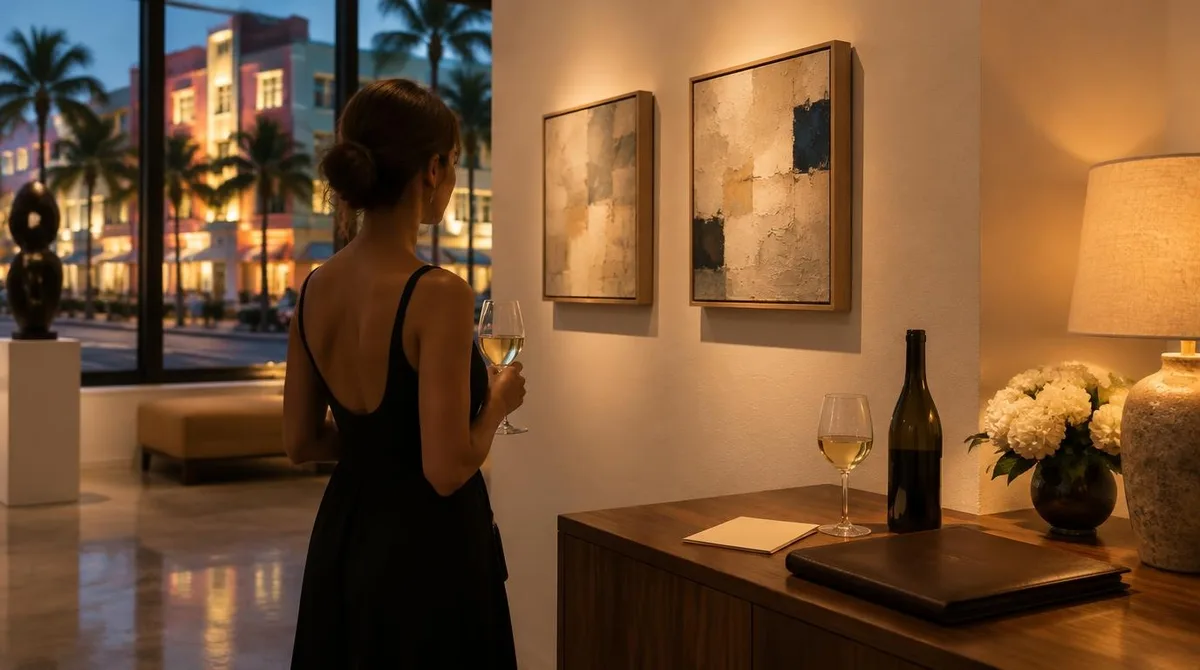
Miami Art Week does not have to cost you a badge, a bracelet or a booking fee. On Friday, December 4, 2026, from 6:00 to 9:00 PM, Federdoc presents Vino & Arte — Italian PDO Wines. Quality Has an Origin. at Lucid Art Gallery in the Miami Design District, and according to citybiz, admission is free and open to the public with advance RSVP through Eventbrite. You get a curated contemporary art exhibition, a pour of Italian PDO wines, and light bites from Borti Pasta Bar — while supplies last on both counts.
The practical question is not whether to go. It is how to go well. Free art-week events fill fast, run on tight pours and tighter timelines, and reward the people who arrive with a plan. Below is that plan, built strictly on what the event listing actually confirms: the date, the address, the RSVP mechanic, the exhibition on view, and who will be in the room.
How do you actually get in?
Three things decide your entry, and all three are in the listing. First, the RSVP: reservations go live on Eventbrite on December 2. Set a reminder for that date, because free events during art week routinely exhaust their lists. Second, timing: the event runs 6:00 to 9:00 PM at Lucid Art Gallery, 10 NE 41st Street, Miami, FL 33137. Third, the fine print that matters most: wine and light bites are available while supplies last. If the pour matters to you, arrive near the start. If the art matters more, a later arrival buys you quieter walls.
- Date: Friday, December 4, 2026
- Time: 6:00–9:00 PM
- Place: Lucid Art Gallery, 10 NE 41st Street, Miami, FL 33137
- Cost: Free with advance RSVP via Eventbrite (reservations open December 2)
- Extras: Italian PDO wines and Borti Pasta Bar bites, while supplies last; complimentary publications including a Federdoc booklet and Live in Italy Magazine's "Wine & Food Guide 2026: A Taste of Place," also while supplies last
What will you actually be looking at?
The event sits inside CHROMA 2026 | CONSTELLATIONS, the fifth annual contemporary art exhibition at Lucid Art Gallery. Curated by the Argentine artist Graciela Montich, it brings together 22-plus international artists working across painting, fine-art photography, sculpture, mixed media and functional art. That range is your advantage as a visitor: in one room you can compare how the same idea moves across a photograph, a sculpture and a functional object — the kind of cross-medium reading that is hard to do when a fair splits artists across booths and floors.
The listing also confirms something rarer: select participating artists will be present and available to discuss their work. This is the part most attendees waste. You do not need a collector's introduction to talk to an artist standing next to their own piece. A single honest question — what are you working on next, or what should I notice first — opens a conversation that no wall text can.
If you want to sharpen that skill before you go, our guide to how to host a studio visit covers the etiquette from the artist's side, and knowing what artists value in a conversation is half of asking better questions in a gallery too. For a wider read on the scene, our artists coverage follows working practices year-round, not just during fair week. For related coverage, see How Working Artists Actually Find Affordable Studio Space in NYC. For related coverage, see How Working Artists Actually Find Affordable Studio Space in NYC.
Why PDO wines are part of the art story
The wine is not a random sponsor grab. Federdoc is the Italian organization representing the Consortia for the protection of Designation of Origin wines — in plain terms, the national confederation that promotes Italy's wine appellations and their tie to quality, geographical origin and regional heritage. According to the event announcement, PDO stands for Protected Designation of Origin, a label that ties a wine to a specific place and a set of traditions. The event's framing — quality has an origin — runs parallel to how contemporary art gets discussed: where something was made, by whom, and under what conditions. Guests will taste a selection of Italian PDO wines chosen to show regional diversity, which turns the tasting itself into a lesson in place. This connects to our earlier piece, Forty-Five Years of Maryland Art Place: What a Baltimore Artist Support Organization Actually Does. This connects to our earlier piece, Forty-Five Years of Maryland Art Place: What a Baltimore Artist Support Organization Actually Does.
The publications on offer deepen that thread. The Federdoc informational booklet covers Italian Designation of Origin wines, and Live in Italy Magazine's "Wine & Food Guide 2026: A Taste of Place" extends the regional theme. Take both; they are free while supplies last, and they outlast the evening.
How to make three hours count
Here is a working sequence, built around what the listing confirms:
- Reserve on December 2. The RSVP window opens that day on Eventbrite. Free plus art week means demand; do not assume you can walk in.
- Arrive early if you want the full tasting. Wine and bites are while-supplies-last, so the 6:00 PM start is the safe bet.
- Do one full loop before you talk to anyone. With 22-plus artists across five mediums, a first walk-through lets you pick two or three works worth a second look instead of stalling at the first wall.
- Find the artists. Select participating artists will be on hand to discuss their work. Talk to at least one. Ask about process, not price.
- Grab the publications on your way out, not your way in — you will carry less and read more.
Why this event matters beyond the free pour
For working artists reading this, the model is worth studying. Lucid Art Gallery was established in 2021 by artist and founder Payal Tak, opened to the public during Art Basel Miami 2022, and runs 3,700 square feet in the Design District as both an exhibition venue and a community gathering space for artists, collectors, designers and cultural events. An artist-founded gallery programming a fifth annual exhibition and pairing it with a cultural partner like Federdoc is a working example of how venues build audiences outside the fair system — programming that treats visitors as guests rather than buyers. Our coverage of galleries and exhibitions tracks these models across cities, because the tactics travel: partner with a non-art brand that shares your theme, keep the door free, and put the artists in the room.
What remains unknown from the listing: which specific artists will attend, the full wine list, and whether the gallery caps entry numbers. Those details may surface closer to the date. Everything above — the date, the address, the RSVP timing, the exhibition, the artists-in-the-room arrangement — comes straight from the event announcement, and that is enough to act on now.