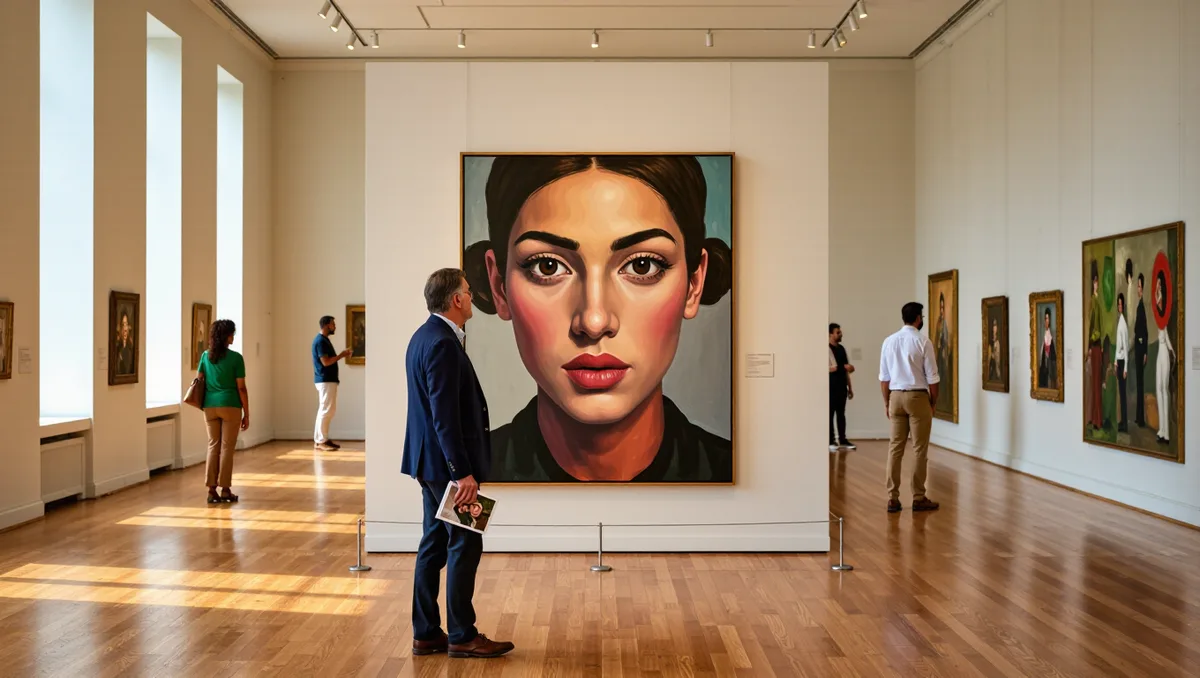
How art exhibitions are made comes down to one crowded stretch of time: the final week before opening, when empty galleries turn into finished shows. Art arrives in crates. Walls go up or come down. Paint dries. Lights get aimed. And a small crew of registrars, art handlers, and curators works long days so that, on opening night, the room looks effortless.
That effortlessness is the point. A visitor should see the art, not the scaffolding of decisions behind it. But every placement, every wall color, every beam of light was chosen, argued over, and installed by hand. Understanding that process changes how you walk through a gallery. You start reading the room the way a carpenter reads a blueprint.
This guide walks through the whole build, from the first floor plan to the last label. If you want the broader vocabulary first — solo shows, group shows, retrospectives — our guide to Exhibitions Explained: Solo, Group, Retrospective, and More covers the types. Here we stay on the floor, with the crates and the crew.
What happens before a single artwork arrives?
Long before installation, the show exists as paperwork. The curator settles a checklist: which works, in what order, borrowed from whom. Registrars then manage the loans, condition reports, and insurance — the slow, careful machinery we describe in How Museums Borrow Artwork: The Long Journey of a Loaned Masterpiece. Each work is photographed, measured, and condition-checked before it travels, so everyone agrees on its state on the day it left.
Meanwhile, someone drafts the floor plan. Curators and designers work in scaled drawings, often with little cutouts representing each piece, shuffling them around a paper gallery for weeks. Sightlines matter. So does sequence: what a visitor sees first, what they see when they turn a corner. A show is an argument told in space, and the floor plan is its outline.
Why do galleries keep rebuilding their walls?
Because the art decides the architecture, not the other way around. A large canvas needs a long, unbroken wall. A video installation needs a darkened bay. A delicate work on paper needs low light, away from the window. So crews frame temporary walls — usually wood studs covered in drywall, then painted — to create the exact rooms a show needs.
Paint is a quiet obsession in this trade. Galleries repaint for nearly every show, and the color is never casual. Bright white flattens and neutralizes. A deep, warm gray can make a painting glow. Some curators specify different shades for different walls in the same room. The paint dries days before the art arrives, because fresh paint off-gasses and smells, and nobody wants that near a canvas.
Who actually hangs the art?
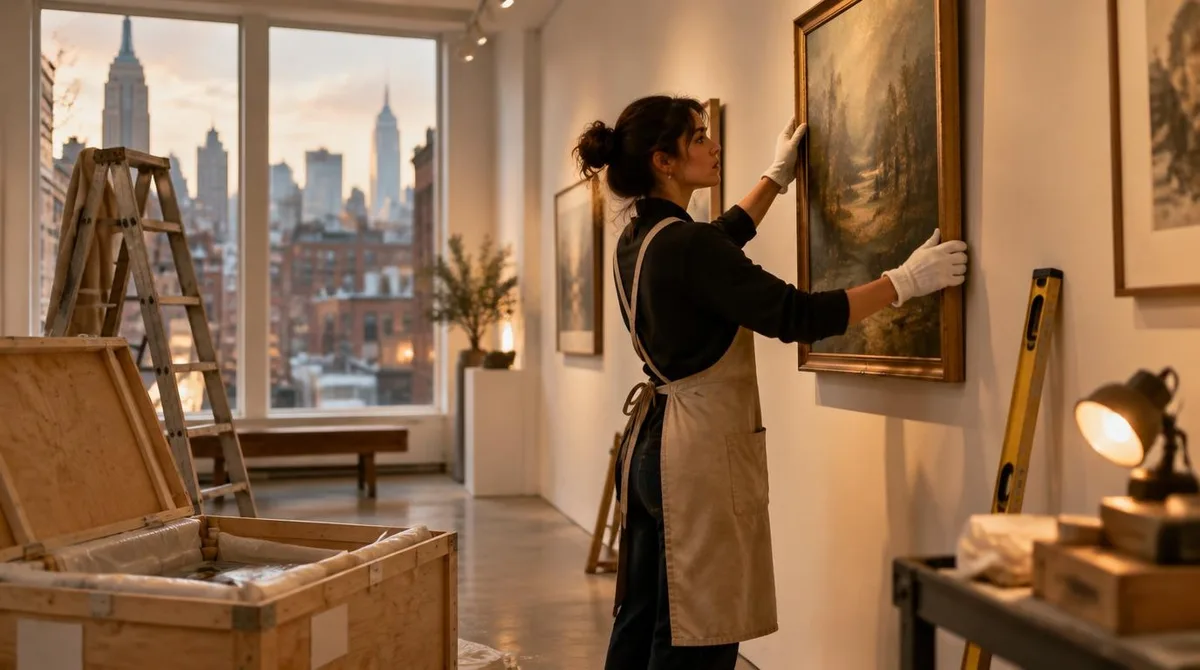
Professional art handlers do, and their work is more technical than it looks. A handler hangs a painting at the height the curator specifies, checks it with a level, and anchors it for weight — a big framed work can weigh as much as a person. Heavy sculptures travel on padded dollies and get set with hoists or extra hands. Every move is choreographed in advance, because improvisation is how things get dropped.
We've written separately about Art Handlers: The Labor Behind the Show, and the short version is this: installation is a skilled trade. Handlers wear gloves, plan every lift, and know the exact panic of a crate lid coming off a fragile surface. When the crew finishes, the walls look untouched. That is the craft.
What does lighting rig work look like?
Lighting is the last big build task, and it can make or break a show. Most galleries use adjustable track lighting: small fixtures on a ceiling rail that slide and pivot. During installation week, someone — often the curator and a lighting technician together — aims each fixture by hand. They test against the actual artwork, not a diagram, because a beam that looks right on paper can wash out a painting's varnish or leave a sculpture in shadow.
Works on paper, photographs, and textiles get dimmer light than oil paintings, since light damage is permanent. That is why one room in a show can feel dim and moody while the next is bright. It is not inconsistency. It is conservation, expressed as atmosphere.
How do big traveling shows get built differently?
Commercial and traveling exhibitions face a different problem: they move, and they must build fast in borrowed buildings. Consider the touring show The Art of Banksy: "Without Limits", which opened at Atlanta's Pullman Yards in September 2026 after runs that the organizer says drew more than 3.5 million visitors worldwide. The exhibition's own materials describe more than 200 works — originals, prints, photos, and sculptures — plus a mirrored Infinity Room, a simulation of Dismaland, and murals painted on site by a production team. Nothing there is bolted to a permanent wall. Every wall, every case, every light rig ships in, gets assembled, runs for a limited season, and comes down again.
Immersive shows push this further. Atlanta Parent rounds up a whole season of them, from Sloomoo Institute's glowing slime-mold light maze to Bubble Planet's LED rooms — builds that are essentially theatrical scenery wrapped around a theme. The installation crew for a show like that thinks less like a gallery and more like a stagehand: power, rigging, crowd flow, and safety come first, and the art lives inside the machine they build.
What this means for a visitor is simple. When you walk into a traveling show, you are walking through a temporary building someone constructed in a week or two. The seams are there if you look: scuffed baseboards, cables taped along the floor, walls that end a little too neatly.
What does the final week before opening actually feel like?
It is a countdown with a hard deadline. Roughly a week out, the walls are painted and the art starts arriving. Days are spent placing works, adjusting heights, and stepping back — a lot of stepping back. Labels and wall texts go up near the end, printed and proofread, positioned at a consistent height. In the last day or two, the crew cleans: scuffs painted out, glass cleaned, floors swept, crates hauled away. We cover the printed side of this in How Exhibition Catalogues Get Made and Who Pays for Them.
Our analysis: the final week is where a show's quality is actually decided. Curation is judgment, but installation is craft, and craft is where good intentions either hold together or fall apart. A thoughtful checklist in a binder means nothing if the lighting tech runs out of time to aim the fixtures. The best shows are built by teams with enough time to fuss — and fussing is exactly what a visitor reads, without knowing it, as care.
So the next time an opening feels effortless, treat that as evidence of labor, not luck. Someone leveled every frame. Someone argued about the wall color. Someone taped down the last cable an hour before the doors opened. The white cube hides its hands, but it has them.