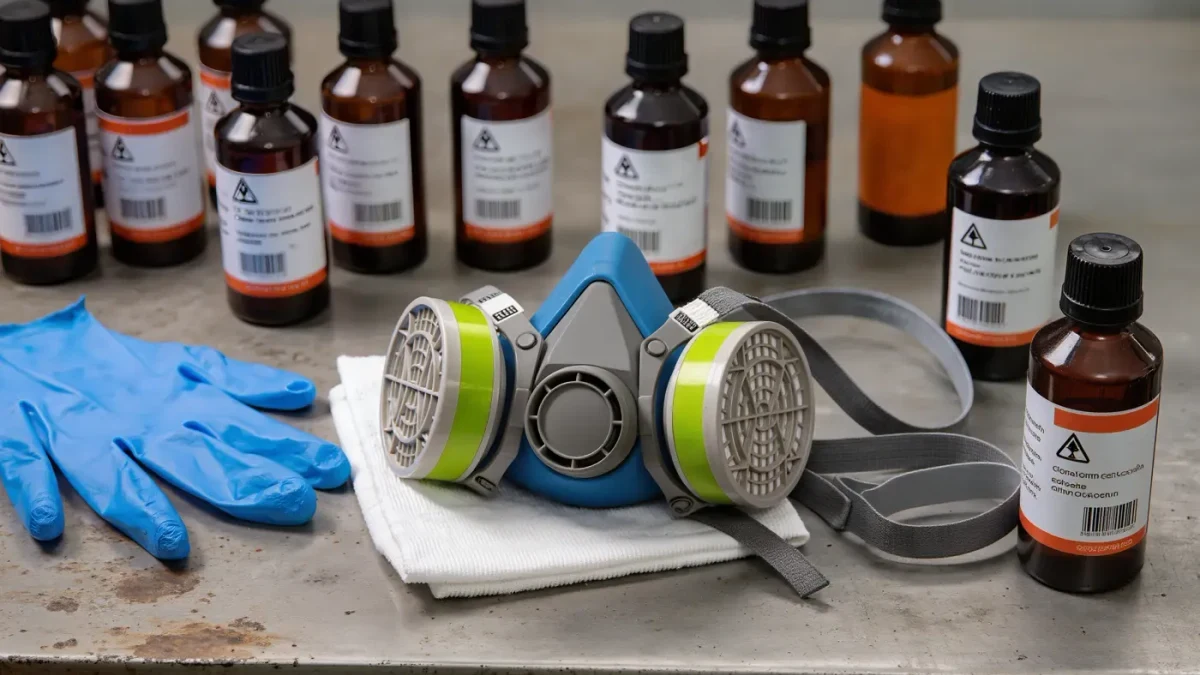
A small studio needs air moving out, solvents kept in closed metal storage, and labels read before anything is opened. The reference points are public: art materials that conform to ASTM D-4236 carry chronic-hazard labeling, and the federal Occupational Safety and Health Administration publishes the guidance trades use. Ventilation, gloves and cartridge respirators do most of the protecting.
None of this is exotic — it is the same hygiene any cabinet shop or body shop runs, scaled to a corner studio in Ridgewood. Read product labels and manufacturers' safety data sheets, and follow OSHA guidance for the materials in question; the label, not habit or folklore, is the law of the room. Where this article says always or never, the label still outranks it.
What are the real hazards in a small studio?
Four, mostly: solvent vapors from mineral spirits, turpentine and cleanup solvents; skin sensitization from resins, epoxies and certain pigments; fine dust from sanding wood, plaster or dry clay; and fumes from spraying, welding or firing. None of them announce themselves — headaches and rashes arrive after the exposure, not during it.
The catalog is longer than most artists want to know. Solvent vapors affect the nervous system, which is why a headache mid-cleanup is information, not inconvenience. Epoxy and resin systems can sensitize skin over repeated contact until a reaction arrives unannounced and permanent. Cadmium and cobalt pigments are beautiful and must not become airborne or sandwich-bound. Silica, present in some clays and plasters, is dangerous precisely because it is invisible at the scale that matters. The pattern is consistent: the hazard is chronic, cumulative and quiet, so the protection has to be habitual rather than reactive.
What kind of ventilation actually works?
Dilution and source capture. A window fan blowing out, with a second opening letting make-up air in, exchanges the room's air constantly; a spray booth or fume hood captures vapor where it is created. What does not work: a fan pointed at the face, a single open window with no flow path, and odorless as a safety claim.
The geometry matters more than the equipment. Air has to travel — in one opening, across the work, out another — so a fan exhausting a window beside the easel, with a door cracked elsewhere, does more than three fans recirculating the same tired air. And the odorless claim deserves its own sentence: odorless mineral spirits smell like nothing and still emit volatile organic compounds, which is a marketing triumph sold to painters as a safety feature. Spraying is its own category entirely — fixative, spray paint and enamel belong outdoors or in a proper booth, because a room that smells fine afterward has simply exported the problem to the artist's lungs.
Which respirator and gloves for which material?
Organic-vapor cartridges for solvents, replaced on schedule rather than on smell; a properly fitted particulate respirator for dust, sealed against a clean face; nitrile gloves for solvent contact, swapped the moment they degrade. The wrong pairing is common — a dust mask does nothing for vapor, and a cartridge respirator does nothing unsealed.
The respirator's honesty test is the seal: if air leaks around the edges, the device is a costume. Facial hair defeats most cartridge masks, and cartridges have shelf lives and service schedules that the manufacturer — again, the label — states plainly. Gloves follow the same logic. Thin nitrile is a barrier of minutes, not days; solvents eat through it eventually, which is why the habit is changing gloves, not trusting them. Latex is the wrong material for solvents entirely. The professionals' trick is worth stealing: buy gloves by the box and treat each pair as single-use insurance rather than equipment.
How should solvents and flammables be stored?
In original labeled containers, inside a closed metal cabinet, in quantities the fire code allows — New York City Fire Department rules cap what a studio may keep on hand. Oily rags go in a metal can with a lid, spread out to dry first, because linseed-soaked cotton can heat itself to ignition. No solvents in drinking cups, ever.
The rag fire is the one that surprises people, because it contradicts intuition: nothing burns, and yet a pile of oil finish rags in a corner can smolder to flame hours after the artist leaves. Spontaneous combustion is documented physics, not studio folklore. The countermeasures are cheap — a metal lid, a spread-out drying rack, or a water dip for rags headed to disposal — and the rest of flammable storage follows the fire code's logic: smallest practical quantities, original labels, sealed cabinets, nothing under the stairs next to the water heater. An ABC extinguisher by the door and a working smoke detector complete the cheapest insurance a studio buys.
What daily habits keep a small studio safe?
Boring ones, done every time: cap solvents between uses rather than at day's end; sand wet or with extraction rather than dry into the room; wash hands before eating and never eat at the chemical bench; empty the rag can weekly. Safety in a small studio is less a purchase than a routine, repeated until it is boring.
- Cap every container the moment you set it down.
- Sand wet, or with a vacuum, never dry into open air.
- Keep food, coffee and cigarettes out of the materials zone.
- Wash hands at the sink, not with solvent.
- Leave the studio cleaner than the day's work strictly requires.
Where do artists find reliable safety information?
On the label and in the safety data sheet, first. The sixteen-section SDS that OSHA's hazard communication standard requires describes hazards, handling and cleanup for each product, and suppliers must provide it. Beyond that: the ASTM D-4236 seal on art materials, the Art and Creative Materials Institute's certifications, and Monona Rossol's long-running Arts, Crafts and Theater Safety organization.
Rossol's work deserves the name-check because she built the field's usable library — her Artist's Complete Health and Safety Guide has been the studio reference for decades, and her organization consults for arts workplaces nationwide. For emergencies, the national poison help line at 1-800-222-1222 answers questions about exposures around the clock. The through-line of every credible source is the same, and it is the one this article keeps hammering: the product's own documentation outranks advice, including this article's. Read it before the cap comes off.
Frequently asked questions
Are odorless mineral spirits safe to use indoors?
They are less odorous, not harmless. Odorless mineral spirits still emit volatile organic compounds, and the label still governs ventilation and gloves. Treating the lack of smell as a clean bill of health is the single most common safety mistake painters make — the headache simply arrives without the warning smell.
Do I need a respirator for acrylic painting?
For plain brush-applied acrylics, generally no — water-based paint is among the lower-hazard media, and decent air movement suffices. Dry pigment, heavy sanding of dried acrylic skins and any spraying change the answer completely. The product label and safety data sheet decide, not the medium's reputation.
How often should respirator cartridges be replaced?
On a schedule, not on smell — by the time a solvent smell gets through, the cartridge was done earlier. Manufacturers state service life for each cartridge type against each chemical family; heavy solvent use means replacement after hours, not months. Store cartridges in a sealed bag between sessions, because they scrub the shelf as eagerly as the room.
Is it safe to spray fixative indoors?
No. Fixative, spray paint and spray varnish produce a directed cloud of solvent and propellant that a room fan cannot keep up with. Take the work outside, or use a proper spray booth with extraction. The studio that smells like fixative at midnight is telling its occupant exactly what was inhaled to make it smell that way.