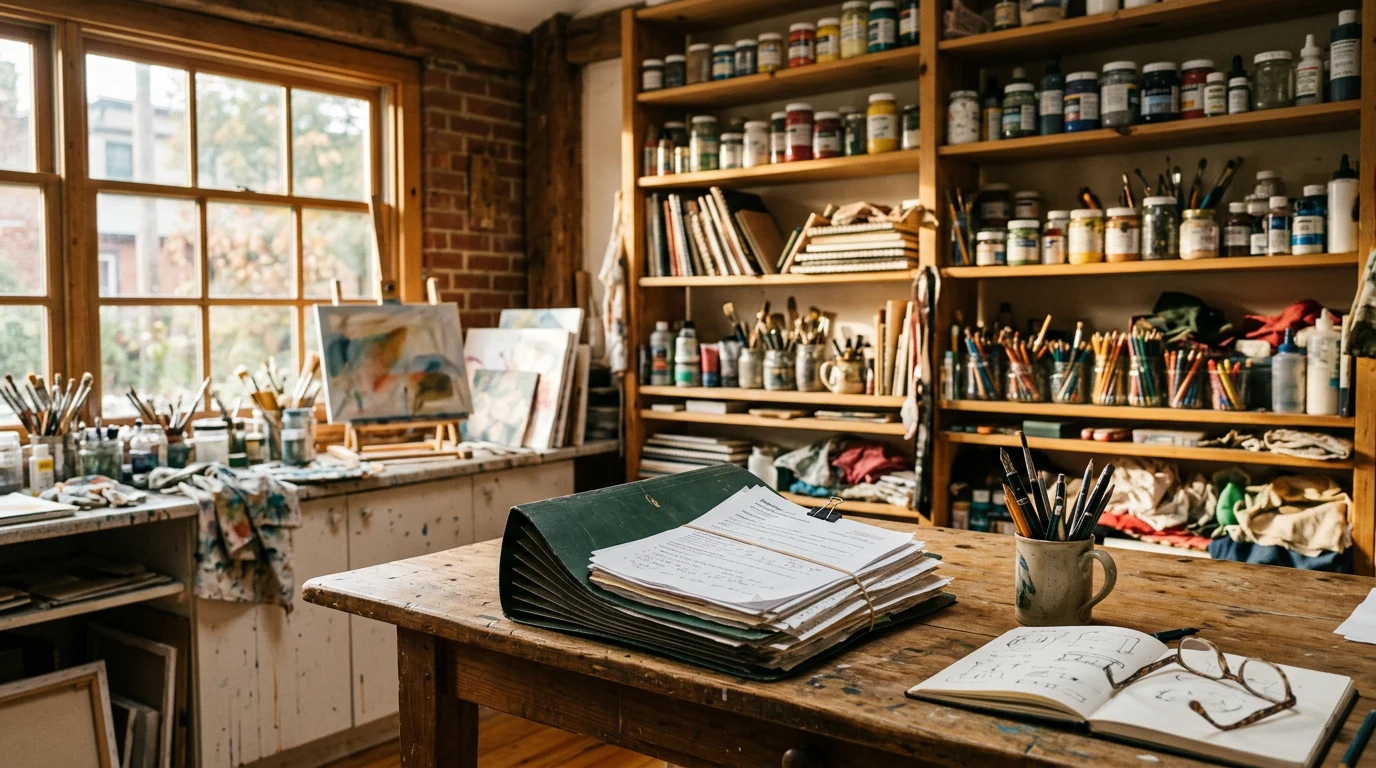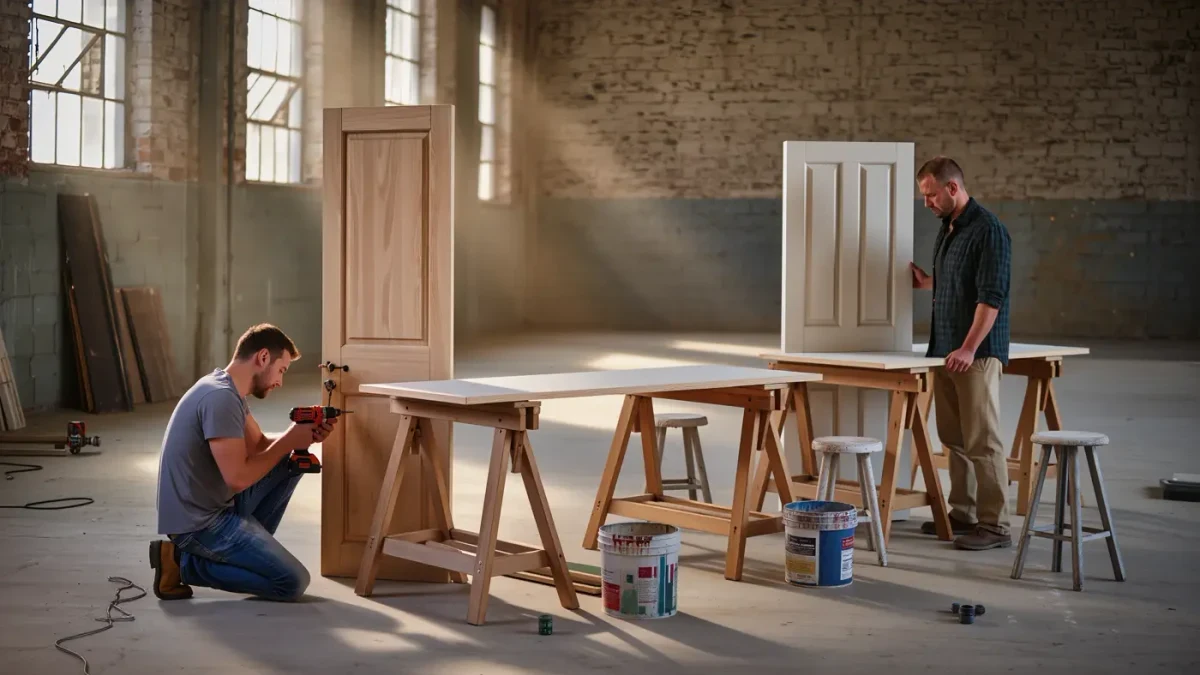
A working studio can be outfitted for the price of a lumber run: doors on sawhorses for tables, restaurant shelving for storage, clamp lamps for light, a box fan for air. New York runs a free materials pipeline — Materials for the Arts in Long Island City — but the deepest savings come from salvage, patience and building it yourself.
The no-budget fit-out is the sector's oldest folk knowledge, passed down shared-studio to shared-studio, and every generation rediscovers it because the economics never change: rent eats the budget, materials eat the rest, and furniture comes last. That hierarchy is correct. Money belongs to the room and the work, not to the objects holding the work — and a studio built by hand tends to fit the practice better than anything a catalog sells.
What does a studio actually need on day one?
Five things: a work table at the right height, light you can see true color by, storage that keeps paper flat and brushes dry, air that moves, and a wall to look at. Everything else — easels, flat files, spray booths — arrives when the work demands it. The empty room is not deprivation; it is the shopping list.
New studios fail by buying the wrong first thing. The painter who purchases a beautiful drafting table before discovering she works six feet wide has spent the budget on an obstacle. Live in the room for a month with almost nothing — a folding table, a chair, the work itself — and the room will teach its actual needs: where the light falls, which wall reads best from fourteen feet, where the dust settles. Then spend, small.
How do artists build worktables cheaply?
The classic is a hollow-core door on two sawhorses — flat, wide, replaceable, and finished when the door is. Sturdier builds use plywood on two-by-four legs; scaffold planks make shelves that hold anything. The rule of thumb from every shared studio: build the table for the work's weight, not the catalog's looks.
Upgrades cost little more. A sheet of melamine on top wipes clean; a torsion box — two plywood skins over a ribbed core — stays dead flat for drafting and printmaking; threaded rod and angle brackets turn scrap lumber into a press that behaves like a store-bought one. Easels follow the same logic: two uprights, a crossbar, a ledge, and the painting stands exactly where the painting needs to stand. Paint every built surface primer white — it makes the room a neutral critic and shows the true colors of the work in progress.
Where do cheap fixtures and storage come from?
The street, the reuse store and the restaurant supply. Month-end sidewalks yield shelves and desks in this city; reuse nonprofits like Big Reuse sell donated building materials cheap; and restaurant supply rows sell stainless tables, wire shelving and rolling carts at prices hardware stores cannot touch. Film productions wrap constantly and sell set-built furniture for next to nothing.
The quiet channels matter as much as the stores. A friendly relationship with a building superintendent produces shelving, paint and old fixtures that were headed for the dumpster anyway. University surplus sales offload tables and flat files when departments move. Curb salvage has its etiquette — take the whole piece, never the parts, and leave the sidewalk cleaner than found — and its seasons: the last days of any month, when the city's leases turn over and the sidewalks fill with other people's upgrades. Wire shelving, the restaurant standard, deserves special praise: it assembles without tools, holds enormous weight, and lets paint drips fall through to be swept instead of pooling into archaeology.
How do you light a raw studio cheaply?
With daylight-balanced bulbs and as many sockets as the circuits can safely carry: clamp lamps on joists, 5000K LEDs overhead, one true-color task light at the easel. Free light matters most — claim the window wall for color work and put storage on the dark side. Never daisy-chain power strips; one fire marshal visit ends the savings.
Color temperature is the whole game. Warm household bulbs flatter everything and judge nothing, which is how a painting leaves the studio a different object than it arrived as. Mixing bulb types compounds the lie, so pick one temperature, buy one batch, and label the sockets so replacements match. The professional habit costs nothing: face the work north-window if the building offers one, keep the task light on the same side every session, and photograph finished work at the same hour the reviews will happen.
What is never worth skimping on?
The boring safety list: a working smoke detector, an ABC extinguisher, a proper respirator for your materials, licensed electrical work for anything permanent, and a ladder with a rating. Secondhand tools, yes; secondhand safety gear, no. The point of saving on furniture is having money left for rent, materials and the things that protect the practice.
The distinction is lifespan, not price. A door table failing mid-career costs an afternoon; a respirator failing costs lungs; a jury-rigged outlet costs the building. This is the fit-out budget's one nonnegotiable line, and it is short — the detector, the extinguisher, the mask, the ladder, the electrician. Everything else in a zero-budget studio is negotiable, replaceable or free, which is exactly what makes the scavenger economy work.
Frequently asked questions
How much does it cost to set up a small art studio?
Less than furniture stores imply and more than zero: the honest answer is that salvage sets the floor. A door-and-sawhorse table, clamp lamps, wire shelving and a box fan can equip a first studio for the cost of a few lumber sheets. The budget bends to patience — the artists who wait for the curb find the curb provides.
Where can artists get free or cheap materials in New York?
Start with the city's own pipeline: Materials for the Arts, the Department of Cultural Affairs program that moves donated supplies to artists and teachers. Add reuse nonprofits for building materials, library discard piles for books, and the month-end sidewalks of any rapidly gentrifying zip code. The city discards aggressively; makers inherit.
Are door-on-sawhorse tables strong enough for real work?
For most painting, drawing and assembly, yes — the door spans wide and the sawhorses carry surprising load. Heavy presses, kilns and welding need built structures, not doors. Reinforce the middle with a third horse for pounding or cutting, and expect to retire the surface, not the structure, when it accumulates history.
How do I improve ventilation in a cheap studio?
With geometry before equipment: a box fan exhausting out one window, a second opening across the room for make-up air, and the work station between them. Cross-flow beats any number of recirculating fans. For anything sprayed or solvent-heavy, no cheap fix substitutes for a real booth or taking it outside — the label decides, not the budget.