Layer the packing, quote the crate separately, and use a carnet for anything that comes home. That is the short version. The cushioning most studios rely on began as a failed wallpaper: in 1957, Alfred Fielding and Marc Chavannes tried to make three-dimensional plastic wallpaper, failed, and found a packing material instead.
Damage in transit is rarely one big hit. It is vibration, pressure, and a box opened with a knife in the wrong place. The fixes are cheap next to the loss. This guide walks the packing order, the crate decision, the customs paper, and the spots where budgets leak. Readers following this should also see Forty-Five Years of Maryland Art Place: What a Baltimore Artist Support Organization Actually Does.
What Goes Around the Work, and in What Order?
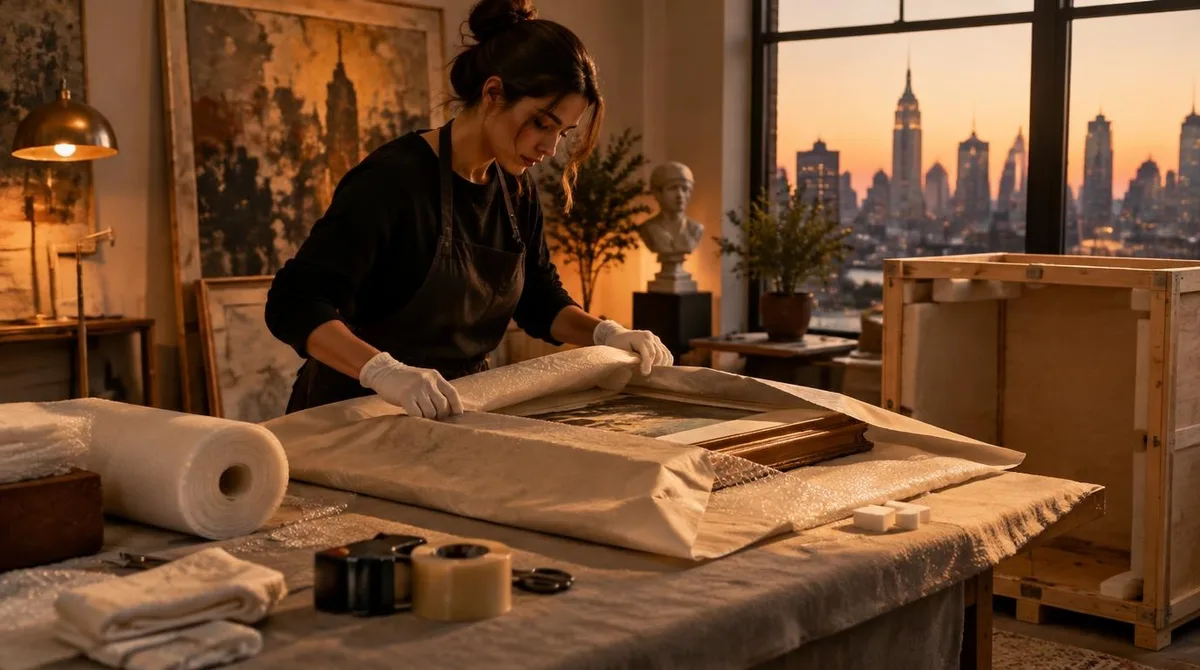
Surface first, cushion second, box third. The surface layer is smooth paper or film; the cushion takes shocks; the box takes handling. Bubble cushioning comes in sizes from 6 to 26 millimeters, and multiple layers isolate shock and vibration better than one thick layer. Bigger bubbles take bigger hits; small bubbles guard flat surfaces. Match the size to the work. Work on a clean table, cut tape away from the art, and seal the box for a stack, not for a shelf.
- 1. Cover the surface with smooth paper, and never let tape meet the work.
- 2. Wrap in two or more cushion layers, bubbles facing out.
- 3. Double-box: a snug inner box inside a larger outer box, with fill between the walls.
- 4. Mark all six sides, then photograph the sealed package for the record.
When Does a Crate Beat a Cardboard Box?
When the work is heavy, oversized, or passing through many hands. Crates hold their size, take a strap, and stack without crushing. Cardboard suits small framed pieces and works on paper traveling flat. The dividing line is blunt: if a handler could drop it or sit on it, the crate has already paid for itself. This connects to our earlier piece, How Bushwick Open Studios Actually Works: A Field Guide.
Budget note: crates cost more at the start and less at the end. A crate declares itself as a known quantity, which is what careful carriers price around. Measure the packed crate, not the artwork, before asking for numbers. A crushed box is the most expensive packaging in the world.
Which Paper Should Never Touch a Painting?
Glassine, at least not until paint has fully cured. The stuff has been recommended for protecting stored acrylic paintings, but it can stick to soft or medium-rich paint, and art conservators do not recommend it for wrapping paintings. The safe pattern is smooth interleaving paper that releases cleanly, tested on a corner before any full wrap. Paper that grips half-cured paint can lift a layer off, and no cushion undoes that.
What About Borders, Fairs, and Work That Returns?
The ATA Carnet, nicknamed the passport for goods, allows temporary admission of goods without paying import duties, generally for up to one year, and it is administered by the World Customs Organization and the International Chamber of Commerce. The system grew out of postwar trade agreements, and it now covers goods for exhibitions, fairs, and professional equipment. One sheet combines the customs declaration and the financial guarantee, and it covers multiple border crossings. For fair weeks and touring shows, that paper is the budget: duties paid twice can eat a season.
Conclusion: Ship Like a Studio, Not Like a Mailing Room
Ship like a studio, not like a mailing room. Smooth paper on the surface, layered cushion, a crate when the work has weight, a carnet when the work comes home, and a photo of everything sealed. Each step is small, and each removes one way art dies in transit. Slow is cheap. Rush fees hit art loads harder than most cargo. The budget follows the same logic: money spent on the pack is the only shipping cost that pays for itself every time.