Do you need art school to become a working artist? No. Plenty of New York artists build real careers without a degree, and plenty of degree-holders never sell a painting. What art school buys you is not skill. It is structure, community, and time. Whether that trade is worth the money depends on what you already have.
This guide compares the two paths honestly: what each one gives you, what each one costs, and what the gallery world actually looks for. The short version is that the work, not the credential, decides most outcomes. But the paths to good work are not equal, and the differences matter more in a city this expensive.
What does art school actually give you?
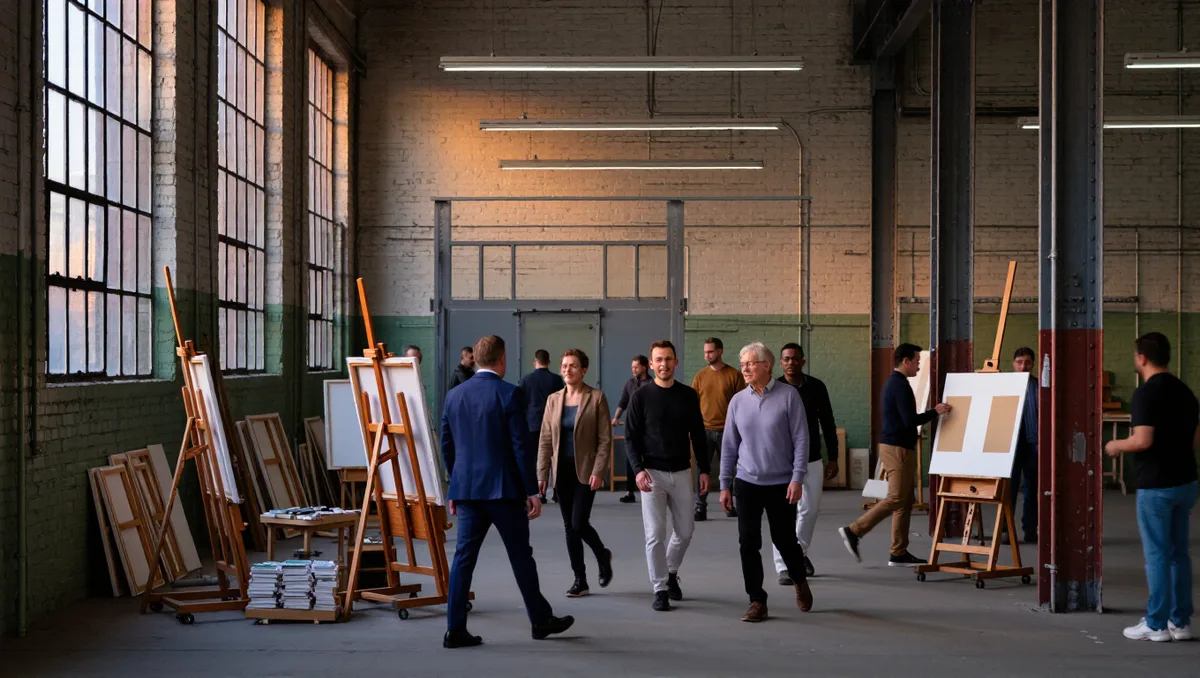
A good program gives you three things you cannot easily buy elsewhere. First, time. Two to four years where making work is your job, with a studio, deadlines, and people who expect you to show up. Second, critique. A room of peers and teachers telling you what fails in your work, weekly, until you develop your own eye. Third, a network. Classmates become curators, gallerists, and fellow exhibitors. In a relationship-driven field, that network often outlasts everything else the degree promised.
There is also the credential itself, and it does less than people assume. Some collectors and institutions still read an MFA as a signal of seriousness. Others read it as a signal of conformity. Neither reading is universal, which is why the degree functions as a door-opener in some rooms and a non-factor in most.
What does the self-taught path look like?
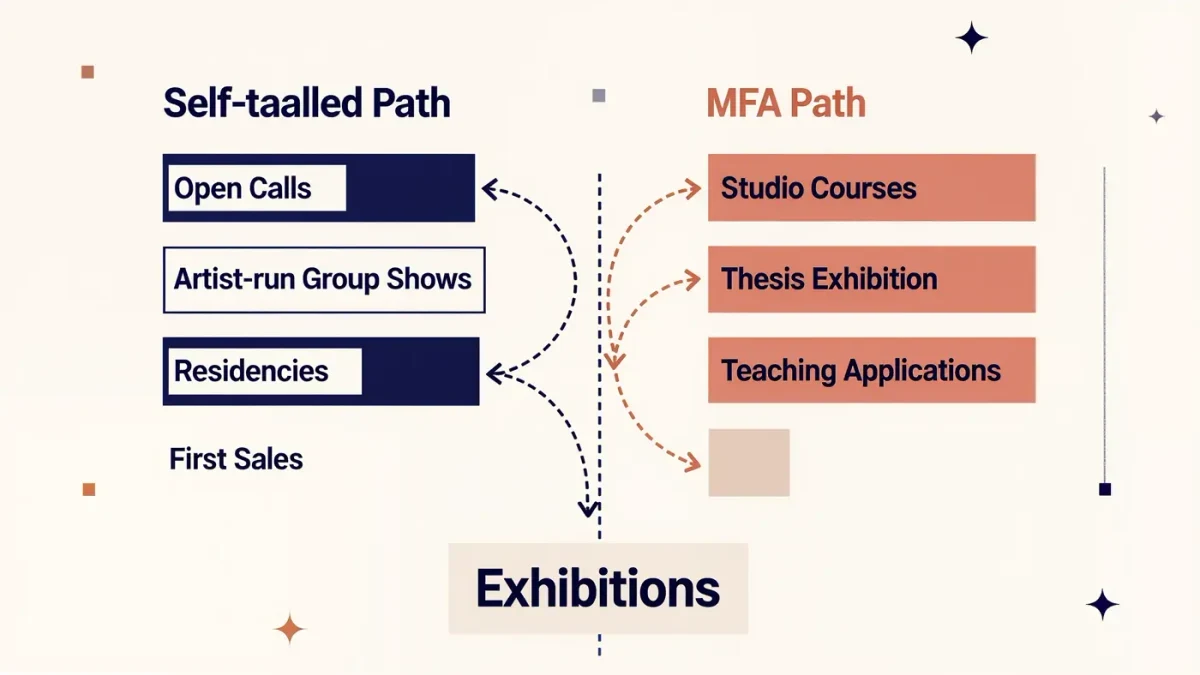
The self-taught path is not one path. It is a bundle of substitutes for what school provides. Instead of scheduled critique, you seek out open studios, artist-run spaces, and group shows where feedback is honest and free. Instead of a built-in network, you build one through group shows, collectives, and studio buildings. Instead of protected studio time, you protect it yourself, usually around a day job.
What this means in practice: the self-taught artist has to be their own registrar, grant writer, and community organizer. That is harder. It is also training the degree rarely provides. Many trained artists graduate fluent in critique and lost when a dealer asks about editions or pricing. The untrained artist who survives has usually learned the business side by necessity.
What does art school cost, and what does it cost a city like New York?
The direct cost of an MFA or BFA is tuition, and tuition at private programs runs high enough that many graduates leave school with debt that shapes their next decade. We will not quote a figure here because the numbers vary wildly by program and residency status, and the honest advice is to price your specific program against your specific finances. The indirect cost is subtler and bigger in New York: years spent paying tuition are years not spent paying rent here, building a studio practice, or applying for the grants that exist for working artists. For related coverage, see Why New York Artists Keep Day Jobs.
Our analysis: the real question is not the sticker price. It is opportunity cost. A self-taught artist spending those years in a Brooklyn studio, working a flexible job and applying to residencies, is accumulating the same assets school claims to provide, just slower and with more risk.
Do galleries actually care where you studied?
Less than the mythology says. Dealers look at three things: the work, the resume of exhibitions and press, and whether the artist can sustain a practice. An MFA shows up on that resume, but so do residencies, group shows, and grants. An artist who has done a demanding residency, shown in credible spaces, and written a coherent artist statement presents the same signals a degree-holder does. We covered a connected angle in How Artist Residencies in New York Work.
Where the degree still matters is access to the first ring of that resume. School crits feed early group shows. Thesis exhibitions bring curators to your studio. Without them, you cold-start, and cold-starting is exactly what building a career without an MFA is about. It is done constantly in this city. It just takes longer and rewards persistence.
So should you go? A practical way to decide.
Ask yourself three questions, in order. Do you have a practice already, or do you need the structure school forces on you? If you cannot yet make yourself work without external deadlines, school may be worth it for that alone. Can you afford it without debt that will force you out of the studio within two years of graduating? If not, the math usually fails. And finally: do you have, or can you build, a community that will critique your work honestly? If yes, the strongest argument for the degree weakens.
There is a middle road worth naming. Short programs, community college courses, and residencies can supply critique and community at a fraction of the cost. A residency is not a degree, but for many working artists it does the part of the degree that mattered: concentrated time, outside eyes, and new peers. Pair it with the free and low-cost materials and space programs the city offers, and the self-taught path starts to look less like a compromise and more like a strategy.
And yet the honest closing note is this: neither path guarantees anything. The art world rewards the work, the persistence, and the relationships, in roughly that order. School is one way to acquire all three. It is not the only way, and in New York it may not even be the cheapest one.
The takeaway on art school and your career
Art school still matters, but it matters as a bundle of resources, not a credential. If you can name what you need from it, time, critique, or community, and get it at a price that leaves you able to keep working afterward, it can be a good investment. If you can assemble those resources yourself, you will graduate from the school of doing it, which is the school most working artists in this city actually attended. Either way, the portfolio decides. Keep making the work.