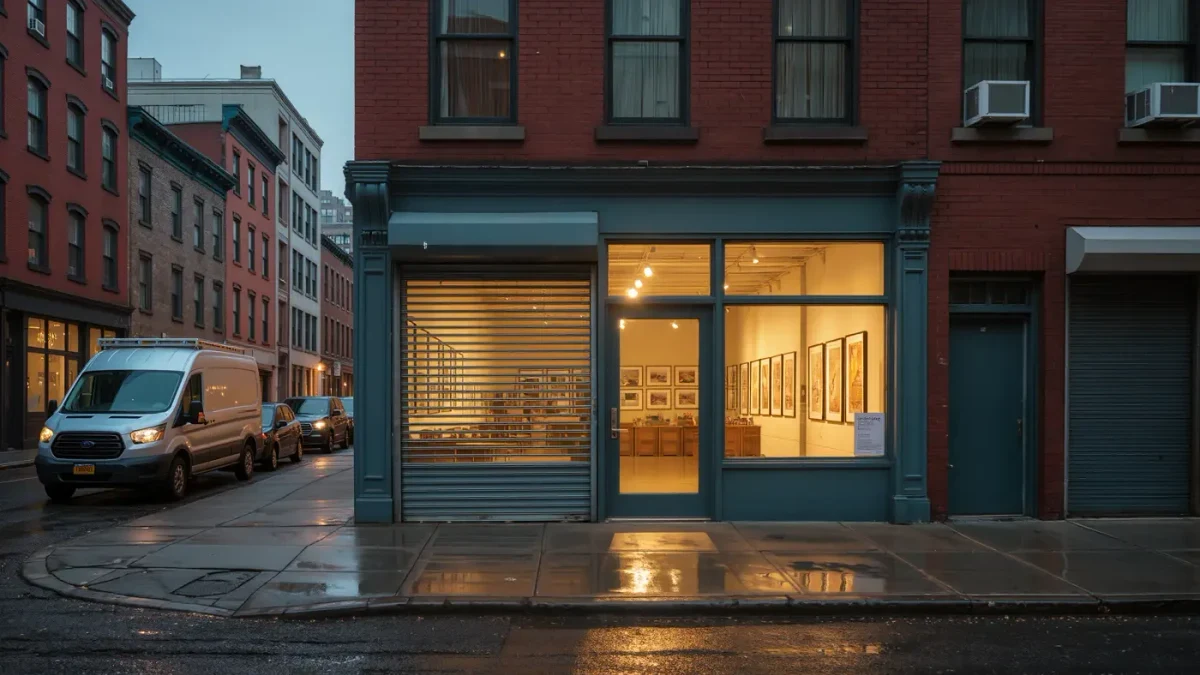
Small galleries survive New York rent by refusing to let one lease be one expense. The same square footage earns storage fees, secondary sales, art handling, advisory work and fair revenue, and the classic move, repeated from SoHo to the Lower East Side to Long Island City, is trading foot traffic for affordable square footage.
Rents shift block by block and year by year, so this piece sticks to structures rather than figures: the ways small dealers have learned to keep a room open in a city that charges premium prices for empty walls.
Why is commercial rent so hard on small galleries?
Because the two sides of the ledger move at different speeds. Rent is due every month, priced by the square foot against some of the most expensive commercial ground on earth, while art sales arrive in lumps: a good fair, a quiet summer, nothing at all for a quarter. Few businesses pair costs so fixed with revenue so erratic.
Lease mechanics sharpen the squeeze. Commercial leases commonly run five or ten years with annual escalations, and small tenants are routinely asked to sign personal guarantees, which put the dealer's own savings behind the rent. A landlord weighing a national retail chain against a gallery selling difficult paintings by unknown artists does not need long to decide. The gallery's credit story is a bet on taste, and landlords are not in the business of taste.
Timing does the rest. Sales cluster around the fairs and the fall season, thin out in August, and depend on a handful of collectors whose attention moves the whole year. A business that can lose money for eight months and make it back in two has to be capitalized like a gamble and run like a monastery.
What do galleries sell besides art to cover the lease?
Almost everything the room can legitimately produce. Secondary-market sales from the back room, where margins need not be shared with a living artist; storage and inventory holding for collectors; art handling and installation services; advisory and collection-management work; editions and multiples at friendlier prices; and event rentals when the calendar allows. The wall is only one product line.
An old line in the trade holds that the front room is a nonprofit and the back room is the business. The front room exists to build the reputation that makes secondary sales possible, and the back room exists to pay for the front room's ambitions. Since 2020, online viewing rooms have added a low-cost channel that keeps inventory working between fairs, though nobody confuses a webpage with a sales season.
None of these income streams appears on the wall. A visitor sees exhibitions; the lease sees invoices for storage, consulting and resale. The galleries that last tend to be the ones honest with themselves about which side pays for which.
Why do so many galleries go upstairs, or to Queens?
Because second floors and outer boroughs trade visibility for volume. A floor-through loft above a hardware store rents for a fraction of street level, and Long Island City, Maspeth and Bushwick have absorbed galleries priced out of Manhattan for exactly that reason. Street traffic was mostly mythical anyway. Serious buyers book appointments.
The tradeoff is cultural as much as financial. Ground-floor spaces catch strangers, and strangers occasionally become collectors, while upstairs rooms catch only the people who meant to come. But the people who mean to come are the ones who buy, and a bigger room shows bigger work, which can mean better business even at the end of the subway line.
Queens deserves its own credit. Long Island City and Maspeth offer the ceiling heights, freight elevators and loading docks that paintings crave, at rents Manhattan has not offered in decades. The borough's gallery population has grown accordingly, and the collectors who once refused to cross a bridge now book the visit like any other appointment.
How do art fairs and shared arrangements keep small rooms afloat?
Fairs compress a season of selling into five days, and for many small galleries they are widely reported to account for anywhere from a quarter to nearly half of annual revenue. Sharing helps too: split booths at younger fairs, consigned booths where artists shoulder part of the cost, and jointly programmed spaces where several dealers divide one address.
None of it is free. Between the booth fee, shipping, flights, hotels and insurance, a fair adventure can consume a season's profit, which is why the smaller fairs, with lighter fees and younger crowds, function as the survival tier of the market. Shared and consigned booths spread the risk further, letting two dealers test one fair before either commits alone.
Cooperation extends past booths. Some young dealers jointly program a single storefront, splitting the lease and alternating exhibitions; others form informal alliances for shipping, storage and staff. The economics of one small gallery are brutal. The economics of four sharing infrastructure look almost reasonable.
Why don't galleries just charge artists to exhibit?
Because a gallery that charges artists for wall space is not really a gallery; it is a rental business wearing a gallery's clothes. In the standard model the dealer invests in the artist, covers the room and the staff, and earns a share only if the art sells. Charging up front inverts the risk and rewards checkbooks rather than conviction.
Rooms that blur the line do exist, and artists should read invitations closely: application fees, mandatory exhibition payments, required marketing charges. Some models sit honestly in between, like cooperatives where the artists themselves share the rent and the labor, a New York tradition reaching back to the 1970s. The test is simple: who carries the risk, and who profits when a painting sells. A room that profits either way has no structural reason to believe in anything.
What happens when the rent still wins?
Closure, usually treated as a business decision rather than a failure of nerve. The dealer becomes an advisor, joins a larger gallery's staff, or retreats to an appointment-only office; the program ends and the artists scatter. Sometimes a move to cheaper space restarts everything. Sometimes the room simply folds into the dealer's phone.
The human order of losses matters. The assistant loses the desk first, then the installer loses the days, then the artists lose a room that believed in them. A neighborhood loses something slower and harder to price, because a gallery is a free public amenity disguised as a store, open six days a week, no ticket required. When one closes, the city gets slightly less explanatory about itself.