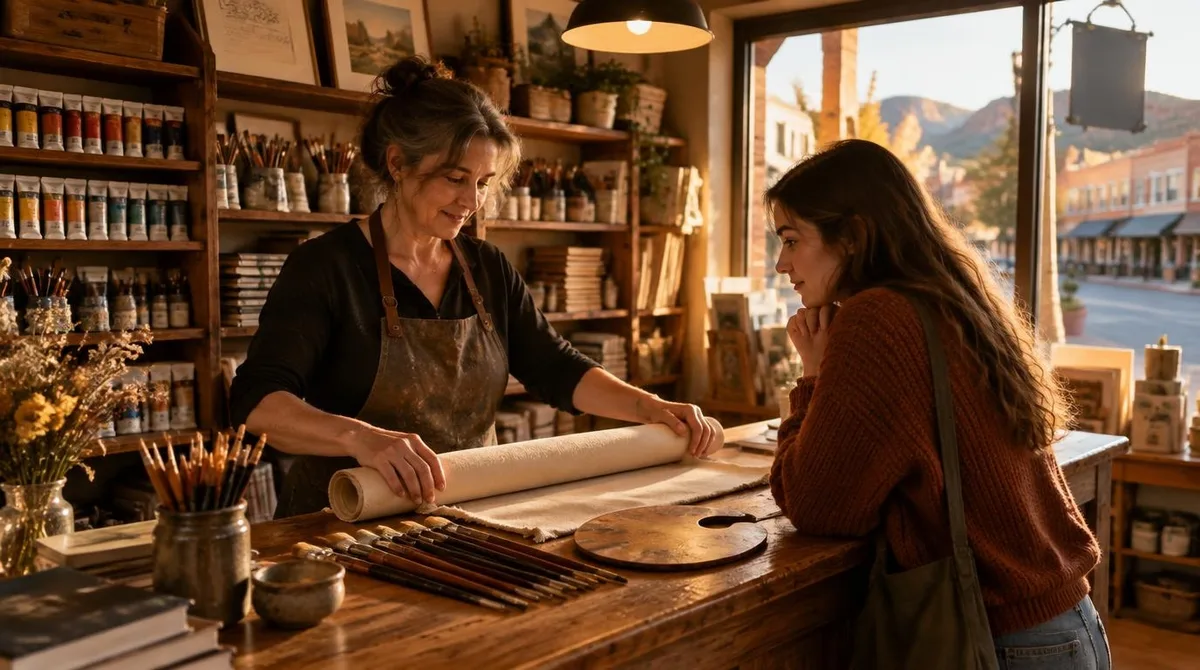
The most important customers at Arts & Music on Fifth Street in Redmond, Oregon, this holiday season are not collectors. They are beginners. According to the Redmond Spokesman, the store's typical holiday customers are new musicians and artists, most of them shopping for a first instrument or a first set of art supplies. Co-owner Lora Hurt calls it exciting, and she is right to.
Why does this matter beyond one shop on Fifth Street? Because every working artist starts exactly there: someone hands them tools, and either the tools work or the person quits. A store that understands this — that treats the first purchase as a relationship rather than a transaction — is doing quiet infrastructure work for a town's creative life. Redmond is a reminder that this infrastructure exists in small towns too, not just in the districts mapped by big-city coverage of galleries in New York and elsewhere.
The Hurts, who took over the family business about three years ago from relatives who opened it in 2019, have built the shop around a simple idea Lora described to the Spokesman: "Since we're an experiential store — hands on — we're putting people in the room playing with other musicians, and then ultimately they can sample supplies and make sure they like what they're finding."
What "experiential" actually buys you
"Experiential" is the kind of wall-text word that usually means nothing. Here it means something concrete. A beginner cannot judge a brush by reading a label. They cannot tell a playable guitar from a decorative one. The store answers that by letting people handle the goods, play alongside other musicians, and sample materials before committing. That lowers the single biggest barrier to starting art: the fear of buying the wrong thing.
The model also solves a service problem most retailers ignore. Art & Music will set up instruments with discounts available, and it will tune and make an instrument playable whether it was bought in the store or somewhere else. That last detail is the tell of a business thinking long-term. A store confident enough to service instruments it did not sell is betting on the town's musicians, not on any single sale.
Holiday gift-buyers are a pipeline, not a spike
Lora Hurt told the Spokesman that the holidays bring in people who want to support the artists and musicians close to them — "loved ones or musician friends." Business picks up around this time of year and stays steady through the end of January.
Read that carefully. The buyer and the user are different people. Someone buys paints for a partner, a used instrument for a friend. The gift is the entry point; the supplies, lessons, rentals, and maintenance that follow are the recurring revenue. This is how a small-town supply shop converts seasonal goodwill into a year-round client base of working beginners. Galleries that sell to first-time collectors face the same math, as our piece on how to read a gallery price list suggests for the buying side.
The network is the real product
Look at who the store works with: local music teachers and art instructors, the Redmond School District, Genesis Unlimited Studios, the Dry Canyon Arts Association, and Northwind Studio. That list is the analysis. The shop is not merely a retailer; it is a hub. Lessons happen in the back studio. Rentals circulate instruments to people who cannot yet buy. Schools and arts associations channel students and members through the door.
This is the same logic that sustains artist-run spaces in big cities — the argument we made in our coverage of why galleries keep relocating applies in miniature: proximity to a community is the asset. In Redmond, the community is teachers, school districts, and a handful of named local organizations. The store's giveaway of more than 200 sets of headphones, while supplies last, is a small example of the same instinct: put a tool in a beginner's hands and they come back. Readers following this should also see Artist Run Galleries — Co-ops and Collectives: Artists Who Became Their Own Dealers.
The owners are practitioners, and that shows
Casey Hurt is a singer-songwriter with five studio albums. The most recent, "Back to the Start," was recorded in the store's own studio. He spent more than a decade in Los Angeles, where his songs were used in television and film, wrote a couple of musicals, and lived five years in New York before moving to Redmond five years ago. "As family was getting older and things were changing, I decided I wanted to come back and be close," he told the Spokesman.
That biography is not color; it is credentials. An owner who has recorded in the back room knows what a beginner's first instrument needs to survive. This week the Hurts travel to Akron, Ohio, with their son Callen to play a song they composed for the LeBron James Family Foundation, set for release on Thanksgiving Day. Owners who still make work themselves understand the customer because they are the customer.
What this means for working artists elsewhere
The lesson generalizes. Small towns sustain art through businesses that sell tools, teach skills, and service what they sell — the unglamorous layer beneath any exhibition scene. For artists weighing where to live and work, a town with a functioning supply-and-service shop, a school district partnership, and an active arts association offers more practical support than a town with a single destination gallery. Our guide to small-town art scenes off the beaten path makes a related case for looking outside the major markets. We covered a connected angle in Best Small Town Art Galleries — Galleries Off the Beaten Path: Destination Art Towns.
The evidence from Redmond is one store and one local report, so no sweeping claims follow. But the shape is clear: holiday generosity seeds a beginner cohort, hands-on service keeps that cohort active, and a network of teachers and local organizations turns activity into a scene. That is how art economies actually start — one playable instrument at a time.