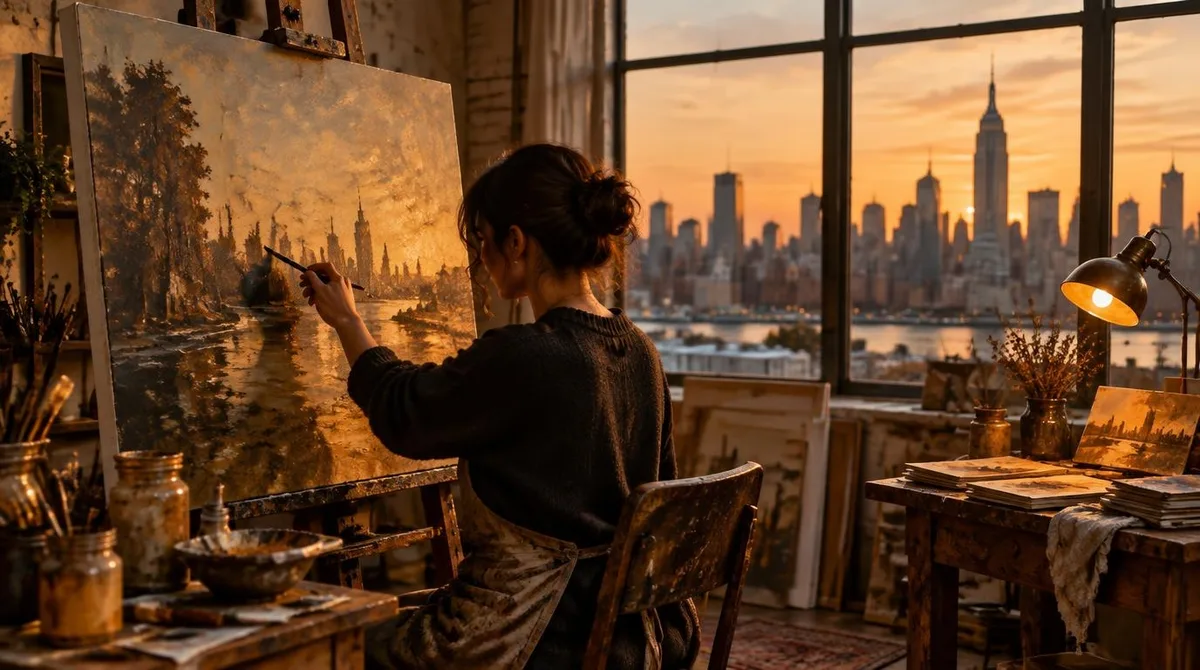
Contemporary landscape artists are painters, photographers, and makers working today who take the oldest subject in art — land — and treat it as something alive, contested, and changing rather than as pretty scenery. What separates them from the tradition is intent: where the old masters gave us ideal views, today's artists use landscape to talk about climate, migration, memory, and who owns the ground we stand on.
The word itself matters here. According to Vocabulary.com, contemporary simply means art that is recent — happening now, characteristic of the present day. So a contemporary landscape artist is not defined by a style. The label covers anyone making landscape work in this moment, whether the medium is oil paint, drone footage, salvaged soil, or sound recorded in a field.
What makes a landscape "contemporary"?
Strip the label down and two meanings survive. One is chronological: the work is being made now. The other is attitudinal: the work engages the ideas of its own time. Dictionary.net defines contemporary as belonging to the present or the modern era, and notes that contemporary art often reflects current concerns — its own example list of contemporary issues includes climate change and digital privacy, which happen to be exactly the concerns driving much new landscape work.
So the genre is less a look than a stance. A painting of a marsh can be contemporary if the marsh is disappearing, if the paint is mixed with sediment from that marsh, or if the artist is asking who gets to visit, name, or own it. A technically perfect sunset vista with no question behind it usually reads as nostalgia instead. The difference is whether the land is a subject or a backdrop.
How are today's artists reworking the tradition?
The classical landscape toolkit — horizon line, atmospheric perspective, the picturesque view — is still in circulation, but working artists bend it in a few recognizable directions.
- Material honesty. Some makers bring the land into the paint itself: pigments ground from local rock, soils, ash, or plant matter, so the picture is literally made of its subject. The landscape becomes evidence, not illustration.
- The damaged view. Instead of the untouched vista, artists frame extraction, wildfire scars, flood lines, and eroded coastlines. The sublime has shifted from awe at nature's power to unease at our own.
- Layered time. Contemporary landscape work often stacks histories in one frame: an indigenous place-name under a highway, a plantation field under a subdivision. The land is treated as an archive.
- New instruments. Satellite imagery, mapping software, drones, and field recordings give artists views no easel could reach, and many combine them with hand-made marks rather than replacing them.
- Social landscape. The frame widens to include people — farmworkers, commuters, displaced communities — treating human activity as part of the terrain, which the older pastoral tradition mostly edited out.
None of these replaces painting. Most of the strongest work we see in exhibitions around the city still involves pigment and a surface. The change is what the pigment is asked to do.
Why does landscape keep coming back now?
Landscape never really left; it just fell out of fashion when abstraction and conceptual art dominated the conversation. Its return tracks the mood of the moment. When the environment becomes a daily, personal fact — smoke in the air, flooded subway entrances, heat waves — the genre stops being escapist and becomes reportage. Landscape is also a naturally political subject, because every acre has a chain of ownership, use, and dispute behind it.
There is a practical pull, too. For artists, landscape is one of the few subjects where material experimentation is cheap and legible: anyone can read a horizon, so a conceptual move made in a field communicates instantly. That accessibility is part of why the genre keeps attracting makers early in their careers, including many of the emerging artists we cover.
What should a viewer look for?
Our analysis: when you stand in front of a contemporary landscape, the fastest way in is to ask three questions.
- What is the material doing? If the surface carries something of the place — dirt, salt, photographic transfer, collage — that choice is usually the argument.
- Whose view is this? Traditional landscape assumed a solitary, entitled viewer. Contemporary work often names or implies a different one: a resident, a worker, a descendant, a trespasser.
- What is out of frame? What the artist refuses to show — the power plant behind the ridge, the fence line, the parking lot — often says more than the vista itself.
These are habits of looking, not a rubric. Good work will answer more than one of them at once.
How does a landscape artist build a career on this?
The business side has its own shape. Landscape work travels well in group shows because it reads quickly, and many painters get their first wall through the routes we've covered elsewhere, like How Artists Get Into Group Shows or How Artists Win First Gallery Representation. Because the genre invites serial production — one place, many studies, one big canvas — pricing and edition questions come up early, which is why our guides on pricing artwork without underselling and on why artists make editions get heavy traffic from landscape painters.
There is also a documentation trap specific to this genre. Landscape borrows constantly — from photography, from maps, from other painters' compositions — and the line between influence and appropriation is thinner outdoors than in the studio. We've written about that boundary in Covering Other Artists: The Fine Line Between Homage and Theft, and it applies with special force when the "reference" is a view thousands of other artists have painted.
Where the genre goes from here
What the evidence supports is modest: the definitional sources establish that contemporary art is art of the present, engaged with present concerns, and that climate and technology sit at the top of those concerns. What remains unknown is which of the current approaches will last and which will date badly — that question can only be answered by the work itself, over time. What we can say is that the genre's center of gravity has moved. The question is no longer "is this view beautiful?" but "what is this view hiding, and who paid for it?" For a subject as old as art itself, that is a real shift, and it is happening on walls, in fields, and in studios right now.