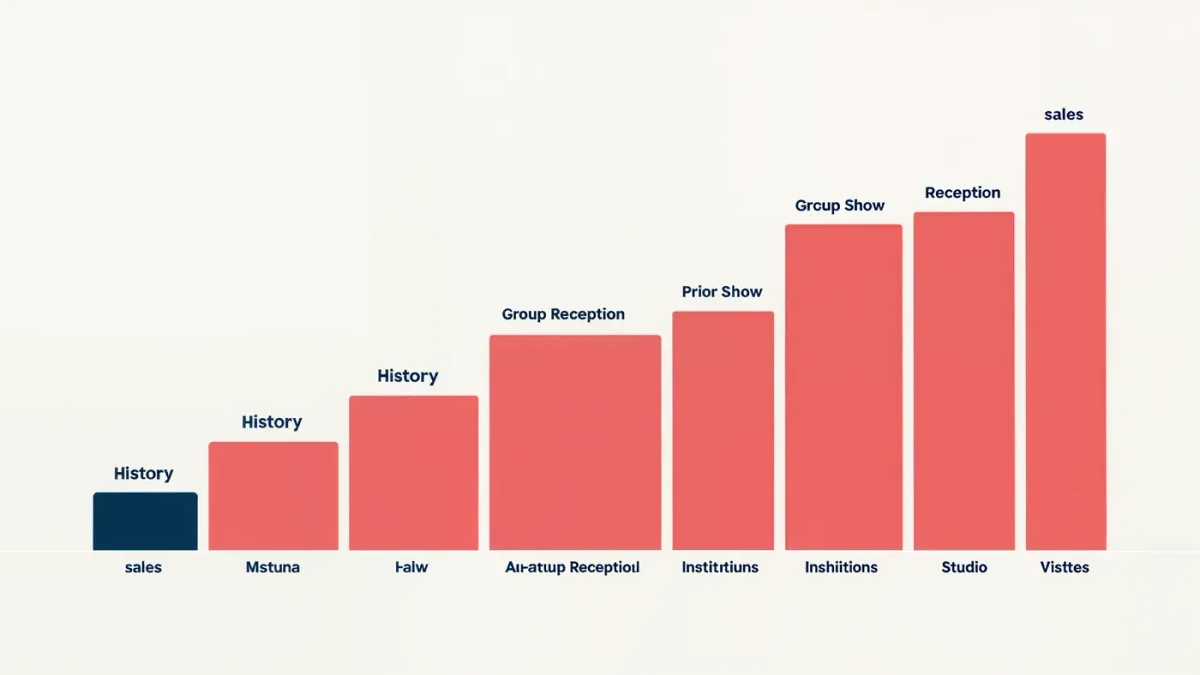
Galleries award solo shows as a wager: this one artist's work can carry a six-week slot that could have held two or three exhibitions. The decision weighs sales history, critical and institutional reception, fair performance and the dealer's conviction, and it is usually made twelve to twenty-four months before the opening, which is why the answer so often feels slow.
What actually triggers the offer of a solo show?
Usually a sequence, not a moment: studio visits over a year or two, a group show that tested the work's reception, steady sales or steady press, and a director deciding the next body of work justifies the room. The offer often lands months after the decision was quietly made, because exhibition calendars force honesty early.
Group shows are the trade's audition rooms. A dealer puts an artist on a summer group wall and watches three things: how the work holds its own beside better-known names, whether collectors who see it follow up, and whether the artist is professionally reliable, shipping on time, delivering what was agreed, answering email. Two of those three have nothing to do with the art, and all three decide the future.
Then there is conviction, the unquantifiable remainder. A director sees a new body of work in the studio and simply decides the room needs it, sales forecast be damned. Program identity matters too: galleries build reputations on the arguments their walls make, and a solo that fits the argument can outrank a solo that fits the spreadsheet. The spreadsheet usually wins. Not always.
How much do sales history and waiting lists matter?
More than anyone enjoys admitting. A previous show that sold through, a waiting list for new work, a collector base that answers emails: these are the strongest predictors a gallery has. Art that does not sell can still earn solos on prestige, but prestige math only stretches so far against rent, booth fees and payroll.
Dealers track sell-through the way stores track inventory, and a show that placed most of its work with serious buyers buys an artist years of patience. Waiting lists do more: a queue of committed collectors means the next solo's outcome is known before the work exists, which is the least risky proposition in a risky business. Price trajectory matters quietly as well, because galleries want artists whose prices can rise show over show without stalling.
The humane caveat deserves stating. Sales-first logic punishes slow, difficult, unphotographable work, and every good dealer knows it, which is why serious programs deliberately schedule shows they expect to lose money on, as statements of identity and loyalty. The artists who get those slots earned them some other way. A gallery is a business running a culture, and the two halves argue constantly.
What role do museums, critics and fairs play in the decision?
They lower the risk. A museum acquisition, a biennial listing, a strong review or a booth that outsold expectations all transfer validation the gallery did not have to manufacture alone. Institutional interest is the cheapest insurance in the business, and galleries read it the way lenders read credit.
Fairs double as auditions because they compress everything into five days. An artist featured in a booth generates data immediately, who stops, who asks the price, who returns with a spouse or an advisor, and curators walk the aisles doing their own quiet scouting. A strong fair showing for a gallery's younger artist has launched many a solo that the calendar had been resisting.
Critics matter less directly than artists hope and more than dealers admit. A review sells almost nothing by itself, but it reassures the hesitant, decorates the press kit and adds a line to the CV that museum committees later read. In a business of accumulated signals, a review is a small stamp that makes the next, larger stamp more likely.
Why do strong artists wait years between solos?
Calendar scarcity, mostly. A gallery running six-week exhibitions gets seven or eight slots a year, and a roster of twenty artists cannot all cycle through, especially once art fairs, installations and collaborations consume their own weeks. The math forces triage, and triage is not a judgment of quality.
Galleries soften the wait with formats: a two-person show that splits the risk and stages a dialogue, a group show built around an argument the artist anchors, a project room for a concentrated gesture. These are real opportunities and not consolation prizes exactly, but every artist knows the difference between a wall and a room. Momentum is the currency careers run on, and long gaps spend it.
Can an artist pitch their way into a solo show?
Almost never through the front door. Cold pitches arrive constantly and are read by assistants with minutes to spare. The routes that work are indirect: build the exhibition record in artist-run and nonprofit rooms, let the work travel, show at open studios, and let the gallery discover what it will then believe was its own idea.
When an artist does get a hearing, dealers look at unglamorous things first: a website that loads, a coherent body of work rather than ten directions, prices that make sense for the record, and signs the artist can deliver an exhibition's worth of work on schedule. The ask that works is never a demand for a show. It is an invitation to the studio, offered once, politely, with new work ready.
What happens after the solo decides what happens next?
The six weeks end and the review begins: how much sold, to whom, at what discount, what the press said, which curators came, what the waiting list looks like now. Galleries run this postmortem honestly, because the room's next season is partly financed by the last show's result. An artist rarely hears the full accounting, which breeds needless anxiety.
Strong outcomes convert quickly into fair placements, firmer prices and a nearer next date. Weak ones produce the polite silence artists know too well, and a longer interval. But reviews can cut both ways: a show that sold poorly and mattered anyway, that made the program's argument in public, sometimes earns a loyalty the spreadsheet cannot see. Either way the verdict arrives in the calendar, never in words. Artists should ask for the meeting, take the notes, and keep working.
In the end a solo is capital allocation. The room is the gallery's only factory, and every six weeks it can manufacture exactly one argument. Artists who understand that the dealer is deciding what the room will argue for, and who make that decision easy, skip the queue more often than the talented who merely wait.